
Last updated September 10, 2026
Full 25-point door and opener safety check with every visit - springs, cables, rollers, tracks, and your LiftMaster or Chamberlain opener included
You get a price before we start. It does not change when the truck arrives.
 Before
 After
After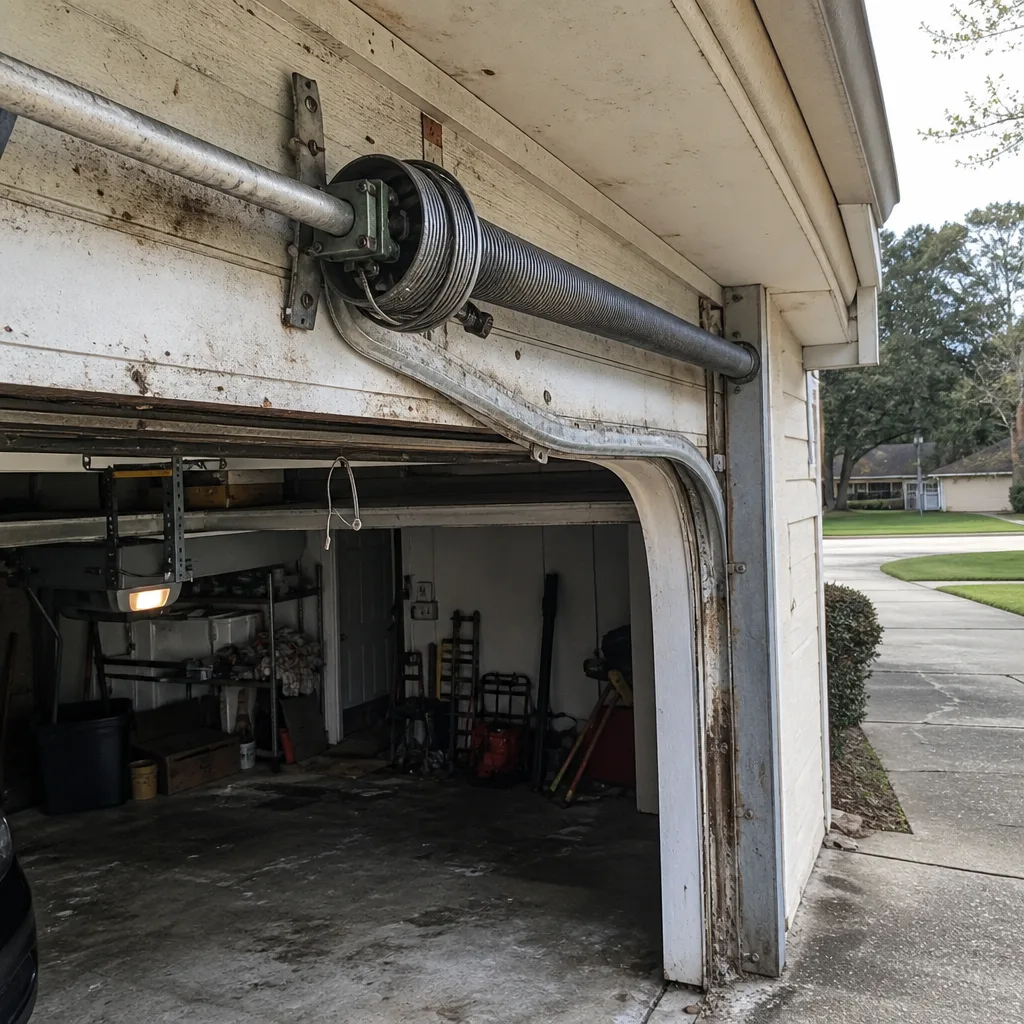 Before
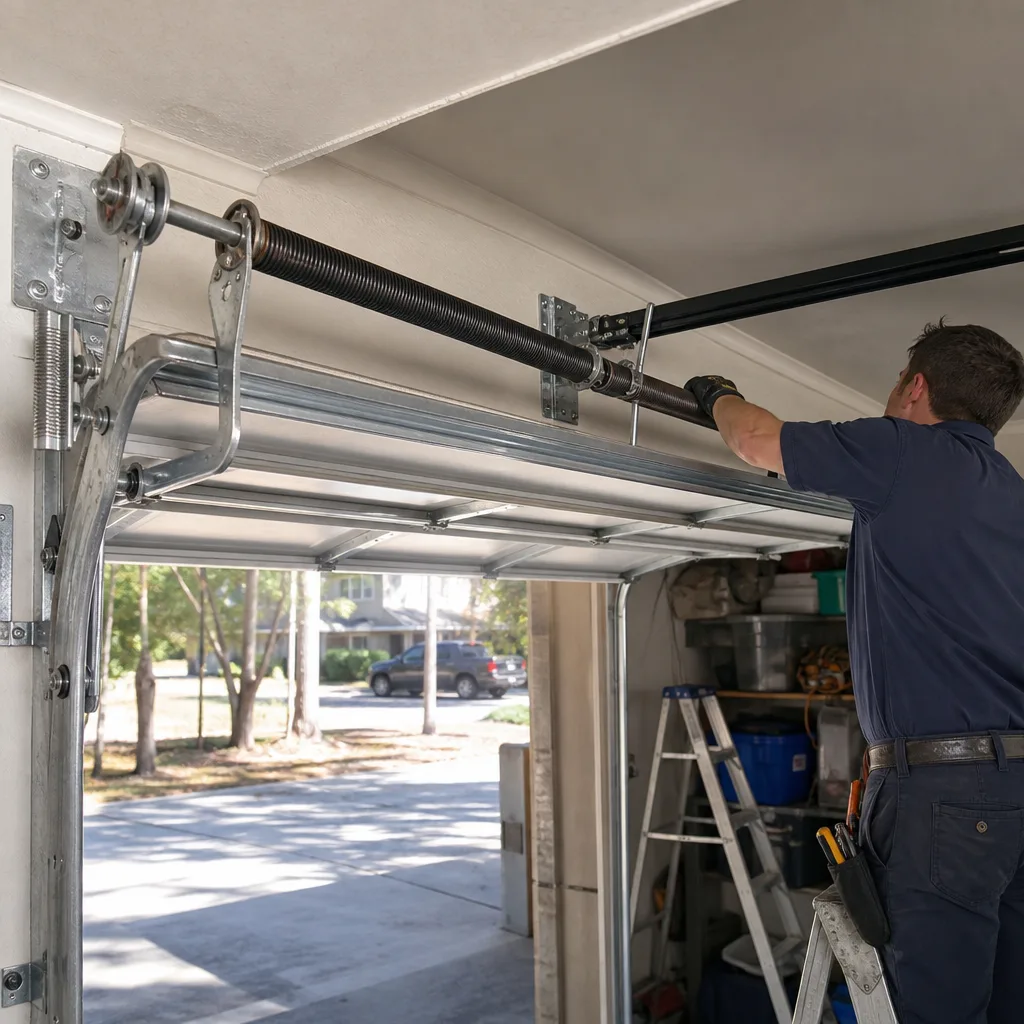 After
After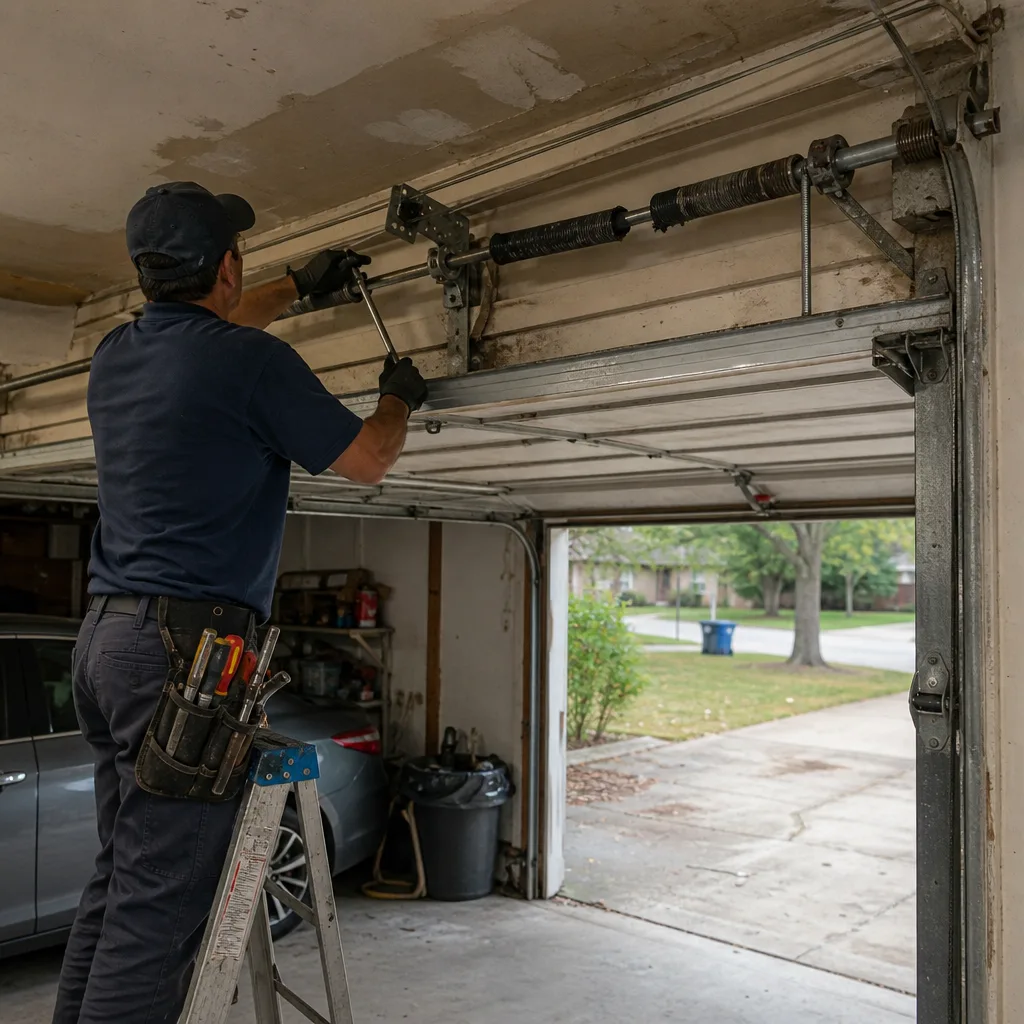 Before
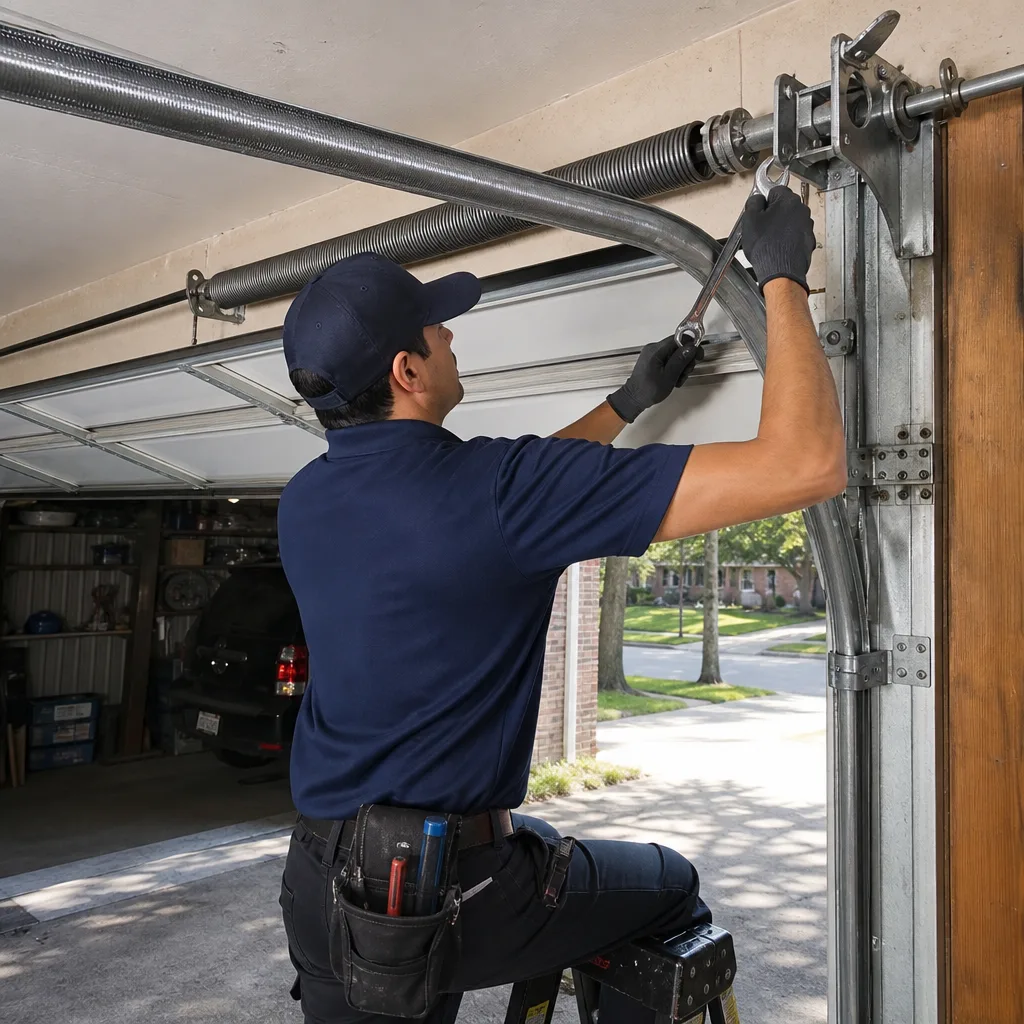 After
AfterGarage Door Warning Signs: A The Woodlands Homeowner’s Reference Guide
Most garage doors in The Woodlands fail gradually, then suddenly. The grinding you have been ignoring for three months becomes a snapped cable at 6:47 on a Tuesday morning. In our 42 years of service, we have learned that every major failure broadcasts early warnings, but homeowners have been conditioned to dismiss them as normal wear. A door that needs two button presses to close is not being finicky. It is telling you the safety sensor alignment has drifted or the logic board is beginning to fail. This guide maps specific symptoms to their exact mechanical causes, separates the warnings you can schedule from the ones that demand you stop operating the door today, and explains what The Woodlands’ humidity and clay soil do to your hardware that inland Texas markets simply do not face. For a deeper dive, see our The Complete Guide to Garage Door in The Woodlands.
Quick Answer
The most critical garage door warning signs are: grinding or popping sounds (failing springs or rollers), uneven movement or sagging on one side (cable imbalance), delayed response or double-button presses (safety sensor or opener logic failure), and visible gaps at panel seams or bottom corners (structural deterioration). In The Woodlands’ climate, horizontal rust streaks on springs and weatherstripping that stays compressed after the door opens are early indicators of moisture damage that accelerates component failure by 40% compared to drier Texas markets.
Table of Contents
- What Specific Sounds Mean: A Symptom-to-Cause Index
- Visual Warning Signs in The Woodlands Climate
- Worn Part vs. Imminent Failure: Knowing the Difference
- How to Test Auto-Reverse and Photo-Eye Safety Systems
- Why Uneven Movement Destroys Cables and Endangers Your Home
- Opener-Specific Warning Signs
- Common Mistakes to Avoid
- When to Call a Professional
- Frequently Asked Questions
What Specific Sounds Mean: A Symptom-to-Cause Index
Your garage door is the largest moving object in your home. It speaks before it breaks. The trick is knowing which sound means which part is dying, and how much time you have.
Grinding during opening or closing. This is almost always metal-on-metal contact where lubrication has failed or rollers have flattened. In The Woodlands, we see this accelerate during spring pollen season, when grit blows into the track and mixes with old grease to form an abrasive paste. The rollers, typically nylon or steel, develop flat spots that thump and grind rather than roll. Left alone, the opener motor strains against the friction and burns out prematurely. We replace the rollers, clean the tracks, and apply a proper lithium-based lubricant, not WD-40, which evaporates and attracts more dust.
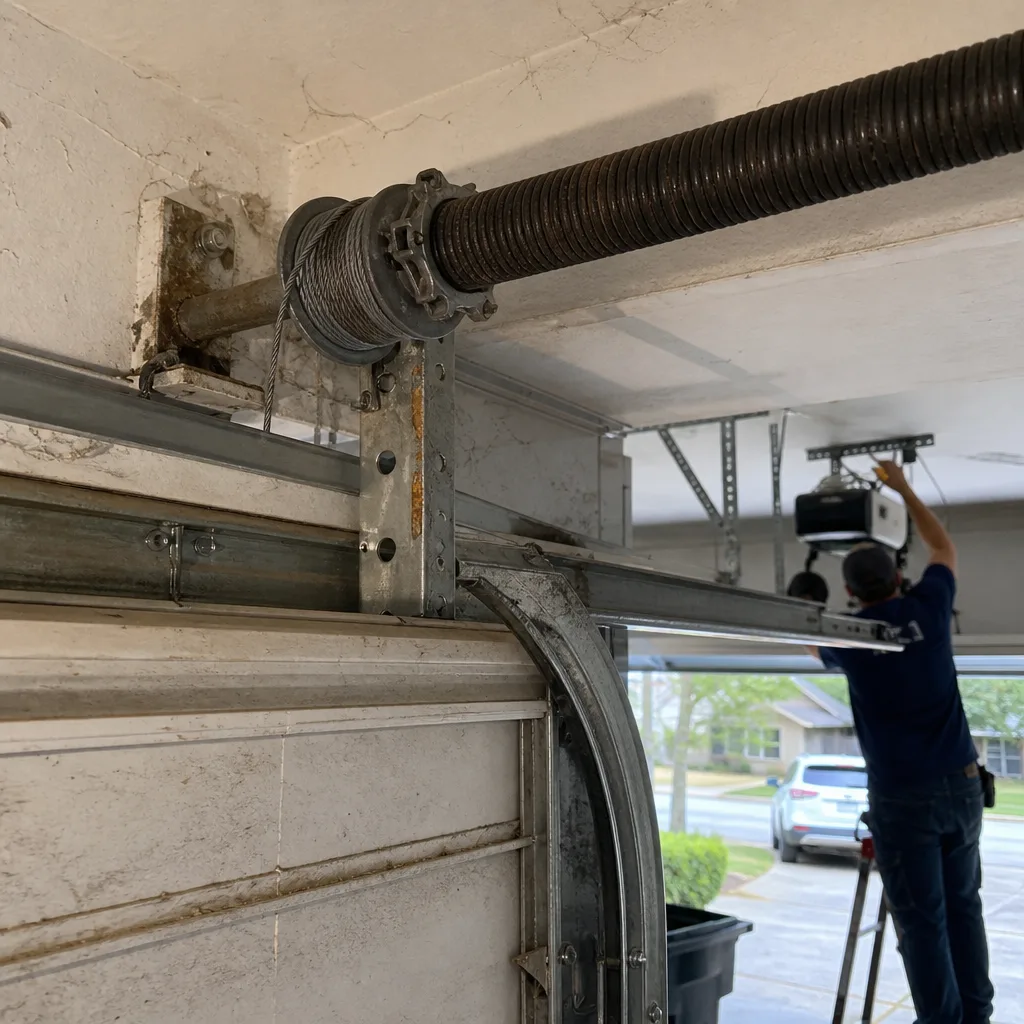
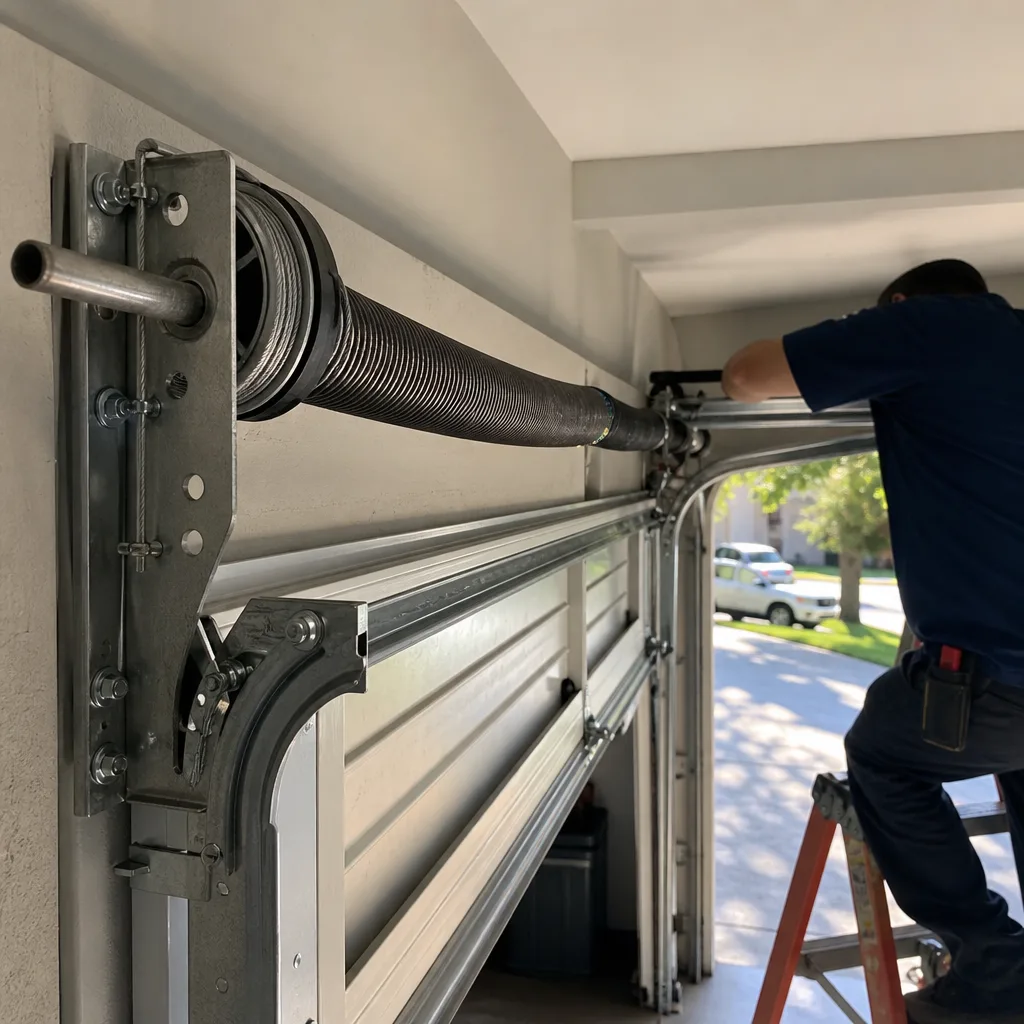
Popping or snapping sounds, especially in morning or evening. This is your torsion spring crying for help. Garage door springs are rated for a specific number of cycles, typically 10,000 for standard springs. Each open-close pair is one cycle. A family of four with two drivers averages 1,500 cycles annually. When a spring nears its limit, the coils bind and release with an audible pop. In Panther Creek and Grogan’s Mill, where many homes were built in the 1990s and still run original springs, we hear this weekly. A popping spring can snap without further warning. A broken torsion spring renders the door dead weight, and the stored energy in a wound spring can cause serious injury or death if handled improperly.
Rattling localized to one side. This indicates a loose cable drum, failing bearing plate, or a cable that has slipped off its groove. The door is no longer lifting symmetrically. One side carries more load. The cable on the overloaded side frays internally before you can see the damage. We have replaced cables in Sterling Ridge that were three days from snapping because the homeowner noticed the rattle but assumed it was a loose bolt.
Squealing that stops after the first few feet. This is usually dry hinges or a dry torsion spring. It is annoying but not immediately dangerous. However, in The Woodlands’ humidity, dry metal rusts fast. What starts as a squeal becomes a grind, then a failure.
Clunking at the top or bottom of travel. The opener’s limit settings are misaligned, or the door is hitting physical obstructions in the track. The clunk is the motor’s gears stripping. Replacing opener gears costs more than adjusting limits or clearing the track.
Our technicians arrive with replacement springs, cables, rollers, and bearing plates on the truck. Most sound-related repairs finish in a single visit. The flat price is stated before any work begins.
Visual Warning Signs in The Woodlands Climate
The Woodlands presents a specific set of environmental stressors that accelerate garage door deterioration. Understanding what our climate does to your hardware helps you read the visual cues correctly.
Horizontal rust lines on torsion springs. These appear as evenly spaced orange streaks across the spring coils. They indicate that humidity has penetrated the factory coating and the steel is oxidizing from the outside in. In The Woodlands, where Gulf moisture lingers and afternoon thunderstorms spike humidity above 85% regularly, we see this on springs as young as five years old. In drier markets, the same spring might last twelve. Horizontal rust lines mean the spring has lost structural integrity. It may still function, but its cycle count is depleted. We replace these proactively during tune-ups.
Bottom-corner panel separation. Look where the bottom panel meets the side stiles. If you see gaps, or the panel appears to sag away from the frame, the internal structure has failed. This is common in The Woodlands homes with south-facing garage doors, where daily thermal expansion and contraction weaken the adhesive bonds. Water enters through the separation, accelerates rust on the bottom brackets, and can warp the panel. A separated bottom panel cannot be repaired satisfactorily. Garage Door Installation in The Woodlands becomes the necessary solution, and we measure on the first visit so the replacement door fits precisely.
Weatherstripping that stays compressed. Healthy vinyl or rubber weatherstripping springs back to shape after the door opens. When it remains flattened, it has lost elasticity. In The Woodlands, UV exposure combined with humidity degradation causes this faster than in northern climates. Compressed weatherstripping no longer seals against rain, insects, or the pollen that coats everything in March and April. More critically, it allows water to pool against the bottom panel, accelerating the separation described above.
Cable fraying or bird-caging. Examine the lift cables where they run from the bottom brackets up to the drums. Fraying appears as unwound strands sticking out like a bottle brush. Bird-caging is when the cable strands bulge outward from the core. Either means the cable is carrying load unevenly and is nearing failure. Do not operate the door. A frayed cable under tension can snap with lethal force.
Track misalignment or bending. The vertical tracks should be perfectly plumb. If you see a bow, dent, or gap between the track and the door rollers, the track has been struck or the mounting hardware has loosened. In The Woodlands’ clay soils, foundation settling is common, particularly in older neighborhoods like Indian Springs. Track misalignment causes rollers to bind, which strains the opener and can pop rollers out of the track entirely.
Opener rail sagging or vibration. The rail that carries the trolley should be rigid. Sagging indicates wall bracket failure or rail joint separation. Vibration during operation means the opener is working harder than designed, usually because the door itself is out of balance.
Worn Part vs. Imminent Failure: Knowing the Difference
Not every warning sign demands emergency response. Some allow you to schedule repair at your convenience. Others mean stop using the door immediately. The distinction saves you money and prevents injury. If you’re planning a larger project, read How to Hire a Garage Door Contractor in The Woodlands: A Step-by-Step Guide first.
Worn Part Warnings: Schedule Within Two Weeks
- Squealing that resolves after the door warms up
- Weatherstripping that is stiff but still seals
- Remote that requires a second press occasionally
- Cosmetic rust on exterior hardware with no pitting
- Door that moves slightly slower than remembered, but evenly
These conditions degrade performance but do not create immediate hazard. They are appropriate for our $89 Seasonal Tune-Up, during which we inspect all components, lubricate moving parts, test safety systems, and flag what will need attention in the coming year.
Imminent Failure Warnings: Do Not Operate the Door
- Popping or snapping sounds from the spring area
- Visible fraying or bird-caging on cables
- Door that sags on one side at any point in travel
- Opener that strains, hums, or smells of electrical burning
- Broken spring (door will not lift, or lifts with extreme difficulty)
- Panel separation that exposes internal structure
Operating a door with any of these conditions risks catastrophic failure, property damage, or personal injury. A broken spring turns a 150-pound door into dead weight that can slam shut. A frayed cable stores enough kinetic energy to sever fingers. If you observe any imminent failure sign, disengage the opener if safe to do so, secure the door in the closed position, and call for emergency service. Garage Door Repair in The Woodlands from Mainspring includes 24/7 response with a live person answering every call.
How to Test Auto-Reverse and Photo-Eye Safety Systems
Since 1993, UL 325 has required all automatic garage door openers to include two independent safety systems: mechanical auto-reverse and photoelectric eyes. These are not optional features. They are federal safety mandates, and testing them quarterly is a homeowner’s responsibility that takes under five minutes.
Test 1: Mechanical Auto-Reverse
- Place a 2×4 board flat on the floor, centered under the door path.
- Close the door using the wall button or remote.
- The door must reverse direction within two seconds of contacting the board.
- If the door stops but does not reverse, or if it crushes the board, the force setting is excessive or the motor’s sensitivity has degraded.
A door that fails this test can crush a pet, a child, or an adult’s foot. The force adjustment is not a DIY repair. The springs and cables are under lethal tension, and incorrect adjustment can mask a mechanical problem while creating a false sense of safety.
Test 2: Photo-Eye Alignment
- Locate the two small boxes mounted 4-6 inches above the floor on either side of the door track. These emit and receive an invisible beam.
- Start the door closing.
- Wave a broomstick through the beam path while the door descends.
- The door must reverse immediately. If it continues closing, the eyes are misaligned, dirty, or failed.
In The Woodlands, photo-eyes fail frequently due to humidity condensation on the lenses and pollen coating that blocks the beam. Cleaning with a soft cloth helps, but persistent failure indicates wiring corrosion or logic board deterioration. We see this often in homes near the golf courses, where irrigation overspray keeps the area perpetually damp.
What a failed test means: A failed safety test means your opener is operating outside federal safety standards. Your homeowner’s insurance may not cover an injury occurring under these conditions. More directly, someone you love could be hurt. Do not bypass the safety systems. Do not prop the eyes up out of the way because they “cause problems.” Call for professional diagnosis and repair. Garage Door Opener in The Woodlands service from Mainspring includes complete safety system testing and adjustment.
Why Uneven Movement Destroys Cables and Endangers Your Home
A door that “works fine” but moves unevenly is a catastrophe in slow motion. This is the warning sign homeowners dismiss most often, and it is the one that causes the most expensive secondary damage.
Uneven movement appears as:
- One side rising faster than the other
- The door appearing to “walk” or twist in the frame
- A visible gap between the door bottom and floor on one side when closed
- The opener rail shaking or jerking during operation
The cause is almost always asymmetric load distribution. One spring is weaker than the other, or one cable has stretched or slipped on its drum. The door’s weight, which should be split evenly, shifts to the stronger side. That side’s cable, drum, and bearing plate take 60-70% of the load instead of 50%. The overloaded components fatigue rapidly. The underloaded side’s spring overextends and loses tension.
Within weeks, the overloaded cable frays internally. The door binds in the track. The opener motor strains against the imbalance and strips its gears. What began as a $200 spring adjustment becomes a $900 repair involving cables, drums, bearing plates, and opener rebuild.
In The Woodlands’ older neighborhoods, we see this pattern repeatedly. Homes in Cochran’s Crossing and Alden Bridge, built during the 1980s and 1990s construction waves, often still run original hardware. The springs were never a matched pair to begin with, or one was replaced years ago without balancing the other. The homeowner notices the uneven movement, adjusts their expectations, and learns to live with it until the day the cable snaps and the door jams half-open during a thunderstorm.
Our diagnostic includes measuring door balance with the opener disconnected. A properly balanced door stays at any position in its travel when released. If it rises or falls, the springs are mismatched. We replace springs in matched pairs, adjust cable tension precisely, and verify balance before reconnecting the opener. The work is covered by our 90-Day Done Right Promise: if the door does not stay where you leave it, we return at no charge.
Opener-Specific Warning Signs
The opener is not the door, but it suffers when the door is failing, and it has its own failure modes.
Delayed response to remote or wall button. You press. Nothing happens for two to three seconds. Then the door moves. This indicates logic board deterioration, failing capacitors, or intermittent radio frequency interference. In The Woodlands, where homes are dense and Wi-Fi networks proliferate, RF interference is increasingly common. But do not assume interference. A delayed opener can fail to respond at all, leaving you locked out or unable to secure the home.
Opener that runs but door does not move. The motor hums or the chain/belt moves, but the door stays put. The trolley has disengaged, or the coupler between motor and rail has stripped. This is not an opener problem alone. It often occurs because the door is so out of balance that the opener’s safety clutch disengages to protect the motor. Fixing the coupler without addressing door balance guarantees recurrence.
Excessive vibration or noise from the opener head. The motor mounts are loosening, or the gears inside the housing are worn. Chamberlain and LiftMaster chain-drive units in The Woodlands homes often develop this after 12-15 years of service. The repair is a gear and sprocket kit, or full opener replacement if the rail is obsolete. We are factory-familiar with all major brands, including Wayne Dalton and Raynor proprietary systems that require specific knowledge to service correctly.
Remote range shrinking progressively. You used to open from the street. Now you must be in the driveway. This is usually failing receiver sensitivity in the opener head, not weak remote batteries. It can also indicate board-level corrosion from humidity. We test receiver sensitivity with calibrated equipment and replace the logic board when indicated.
LED lights on the opener flashing in patterns. Modern openers flash error codes. Two flashes typically indicate a short in the wiring. Five flashes mean motor overload. Consult your manual, but do not reset repeatedly without diagnosis. Repeated resets on a failing motor can cause fire.
Common Mistakes to Avoid
- Assuming a slow door just needs lubricant. In The Woodlands, we see homeowners spray WD-40 on everything and call it maintenance. WD-40 is a solvent, not a lubricant. It strips existing grease, attracts pollen and dust, and creates the grinding paste described earlier. Proper garage door lubrication requires lithium grease on metal-to-metal contacts and silicone spray on weatherstripping.
- Replacing only one spring. Torsion springs are a matched system. Replacing one and leaving the other guarantees asymmetric load and the cable destruction described above. We replace springs in pairs, period.
- Ignoring the door because the opener still works. The opener is not designed to lift an unbalanced door. It will try, and it will destroy itself in the process. A $200 spring repair ignored becomes a $600 opener replacement.
- Testing auto-reverse with your hand or foot. The test requires a rigid object like a 2×4. Using your body risks injury and tells you nothing accurate about force settings.
- Assuming all technicians are equivalent. In The Woodlands market, we have seen unlicensed operators install springs with incorrect winding, leave safety systems bypassed, and disappear when callbacks are needed. Verify licensing, insurance, and physical local presence. Mainspring has served this community since 1984 with background-checked, uniformed technicians trained under our K.E.Y.S. values code.
- Waiting for total failure before calling. Emergency service costs more, and you lose choice of scheduling. A door that fails on Friday evening leaves you exposed all weekend. Proactive repair is less expensive and far less stressful.
- Buying parts online and attempting DIY spring or cable work. Torsion springs store enough energy to kill. YouTube videos do not convey the tactile knowledge of proper winding, securing, and tension release. We have been called to homes where a DIY attempt bent the door, damaged the wall, or sent the homeowner to the emergency room. The money saved is not worth the risk.
When to Call a Professional
Call when you observe any imminent failure sign, any safety system failure, or any symptom you cannot confidently diagnose. The cost of a service call is modest compared to the cost of a door that falls off its tracks, an opener that burns out, or an injury that changes your life.
Specifically: call if you hear popping from the spring area, see cable fraying, notice uneven movement, smell electrical burning from the opener, or if either safety test fails. Call if your door is more than fifteen years old and has never had professional service. Call if you are unsure whether a symptom is serious. We would rather inspect and find nothing than respond to an emergency that prevention would have avoided.
Mainspring Garage Door Co. home | Mainspring Garage Door Co. offers free estimates in The Woodlands. A live person answers every call, 24/7, including nights, weekends, and holidays. Call (346) 682-0797 to speak with us directly.
Frequently Asked Questions
Most common repairs in The Woodlands range from $180 for roller replacement to $340 for standard torsion spring replacement, with multi-spring or high-lift systems running higher. We state the flat price before any work begins, and our $50 Off Any Repair Over $250 standing offer applies automatically. Call (346) 682-0797 for an exact quote - estimates are free.
Yes. A standard torsion spring stores roughly 10,000 pounds of torque energy when wound. Improper release or winding can cause the winding bar to strike with lethal force. We do not provide DIY spring instructions because the risk is genuine and unforgiving. Our technicians are trained as journeymen and carry the correct tools for safe handling.
Test auto-reverse and photo-eyes quarterly, and after any impact to the door or track. In The Woodlands, where humidity and pollen interfere with photo-eye function more than in drier climates, monthly visual inspection of the lenses is prudent. Clean them with a soft dry cloth when you notice accumulation.
The Woodlands’ summer humidity swells wooden doors and affects steel expansion. Opener electronics also suffer in garage temperatures exceeding 95 degrees. If the door binds seasonally, the track alignment or spring tension may need adjustment for thermal expansion. A tune-up identifies whether the issue is environmental or mechanical.
Our trucks are stocked with springs, cables, rollers, bearing plates, and openers from all major brands, including Amarr, Craftsman, and legacy Wayne Dalton and Raynor systems. Most jobs complete in a single visit. If your door or opener is obsolete, we explain replacement options with upfront pricing and no pressure.
Every completed job is covered by our 90-Day Done Right Promise: if the work is not right, we return at no charge, in writing, with no dispute process. This applies to all labor and parts we install. We have honored this promise since 1984, and we put it in writing on every invoice.
The Bottom Line
Your garage door warns you before it fails. The grinding, the sag, the delayed response, the rust line on the spring - these are not quirks to tolerate. They are specific mechanical distress signals with specific causes and timelines. In The Woodlands’ climate, humidity and clay soil accelerate deterioration that drier markets do not face, making attentive observation more valuable here than elsewhere. Learn the sounds, perform the safety tests quarterly, and distinguish the worn part you can schedule from the imminent failure that demands immediate professional attention. Visit our more guides & resources for additional homeowner tips. The homeowners who avoid emergencies are not lucky. They are simply the ones who listened when the door spoke.
Written by Carl Dutton, Owner at Mainspring Garage Door Co., serving The Woodlands since 2016.