
Last updated September 10, 2026
Full 25-point door and opener safety check with every visit - springs, cables, rollers, tracks, and your LiftMaster or Chamberlain opener included
You get a price before we start. It does not change when the truck arrives.
 Before
 After
After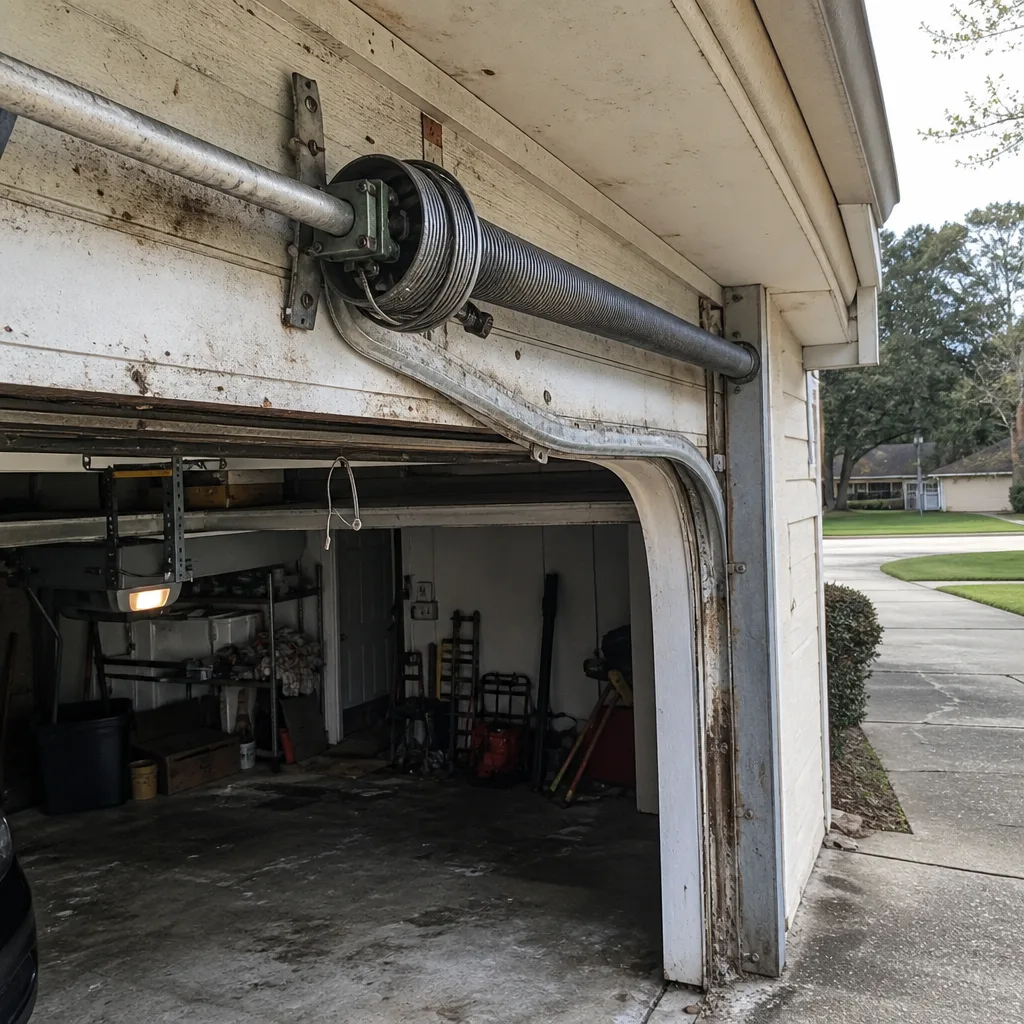 Before
 After
After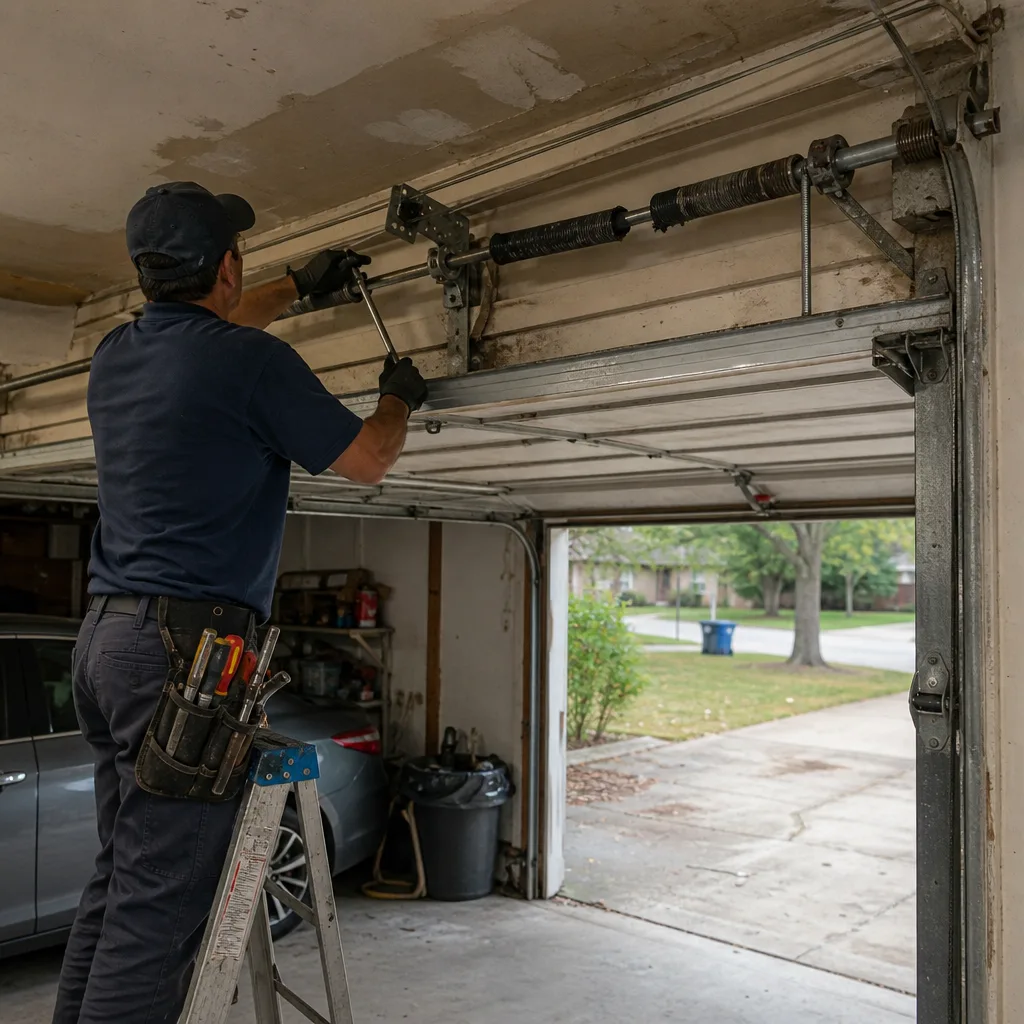 Before
 After
AfterGarage Door Repair Maintenance Checklist for The Woodlands Homeowners
A loose bottom seal costs about four dollars in weatherstripping. A failed torsion spring costs roughly $200 and drops a 200-pound door without warning. Yet most maintenance checklists treat both as equally routine “maintenance tasks.” In The Woodlands, where summer humidity hangs above 80% for months and afternoon thunderstorms drive horizontal rain against garage doors, that equal treatment is not just unhelpful. It is potentially dangerous. This guide ranks every maintenance task by consequence, so you know exactly where to spend thirty minutes, what to watch for in our local climate, and when to call a technician for Garage Door Repair rather than risk injury or void your warranty.
Quick Answer
The Woodlands homeowner should perform monthly auto-reverse and visual cable checks, quarterly roller and track inspection, and annual professional spring tension testing and full hardware torque verification. Tasks involving torsion springs, cable tension, or opener force-limit adjustments should be left to trained technicians, as incorrect work voids most manufacturer warranties and carries serious injury risk. Log all observations with dates and photos so any intermittent problem can be diagnosed in a single visit rather than through repeated callbacks, and check our more guides & resources for additional homeowner tips.
Table of Contents
- The Tiered Checklist: Safety-Critical vs. Routine Maintenance
- How The Woodlands Climate Accelerates Wear
- Monthly Checks You Can Do in 10 Minutes
- Quarterly Maintenance: 30 Minutes of Prevention
- Annual Tasks Requiring a Professional
- Lubrication Schedule for High-Heat Environments
- How to Log Observations and Save on Diagnostic Calls
- Which DIY Repairs Void Your Manufacturer Warranty
The Tiered Checklist: Safety-Critical vs. Routine Maintenance
Most checklists fail because they bury life-safety items between “wash the door” and “touch up paint.” We have sorted every task into three tiers based on what happens if it fails.
Tier 1: Safety-Critical (Failure Causes Injury or Sudden Door Drop)
These are not maintenance tasks in the casual sense. They are inspections that reveal whether your door is currently dangerous. Perform monthly. If any item fails, stop using the door and call a professional.
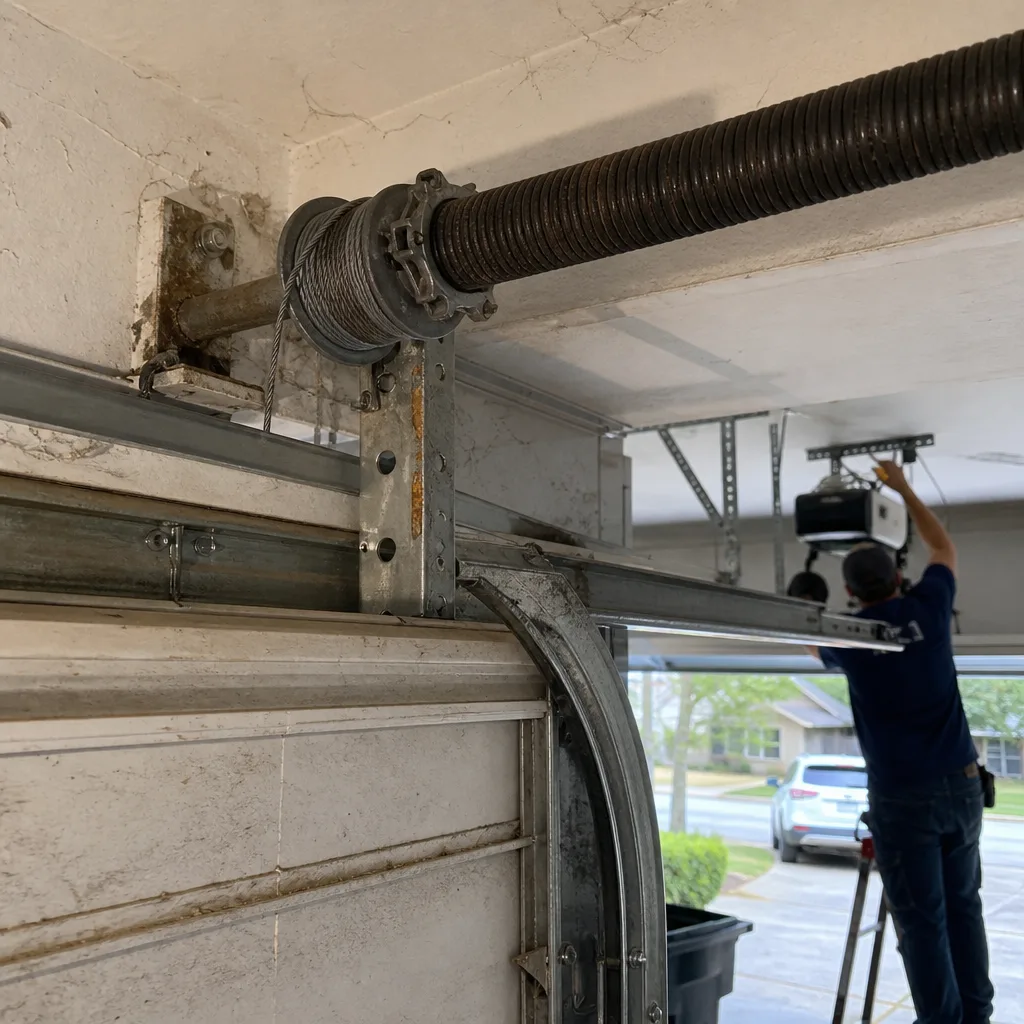
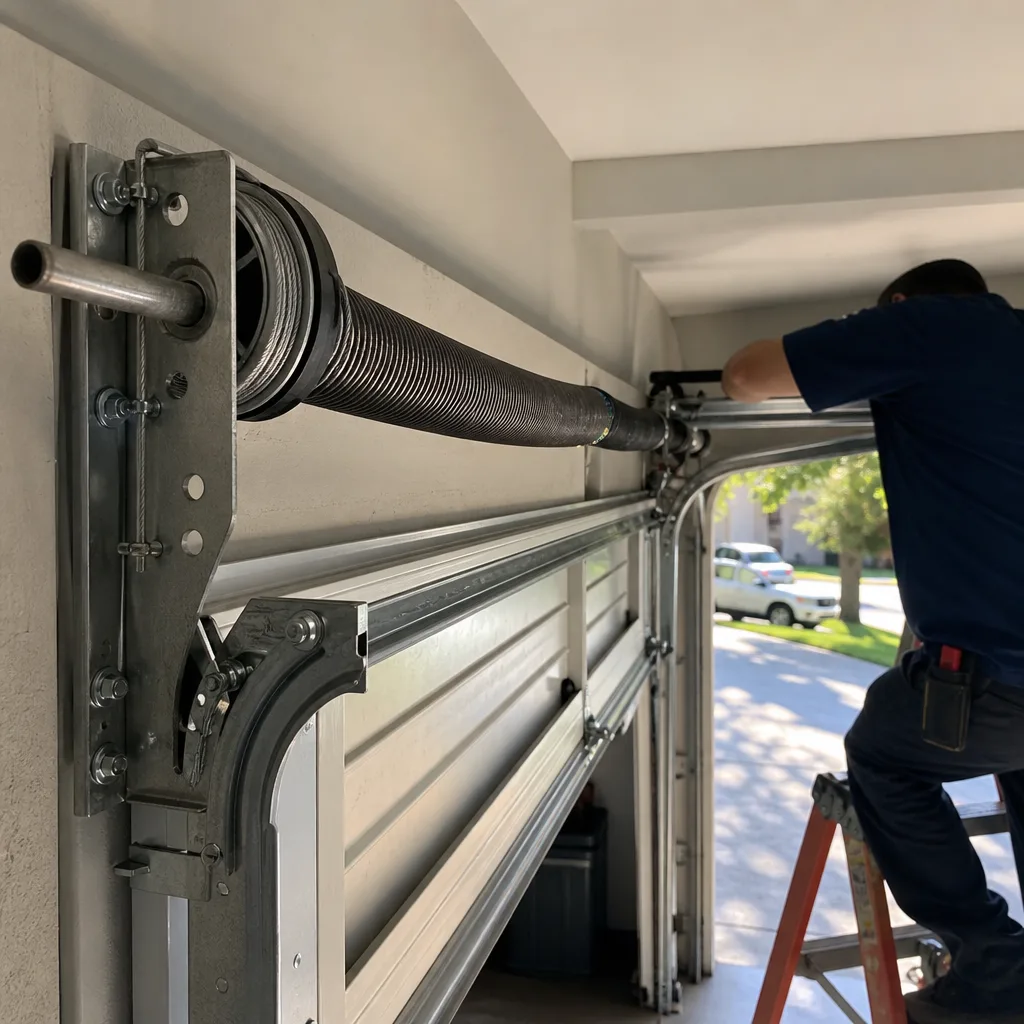
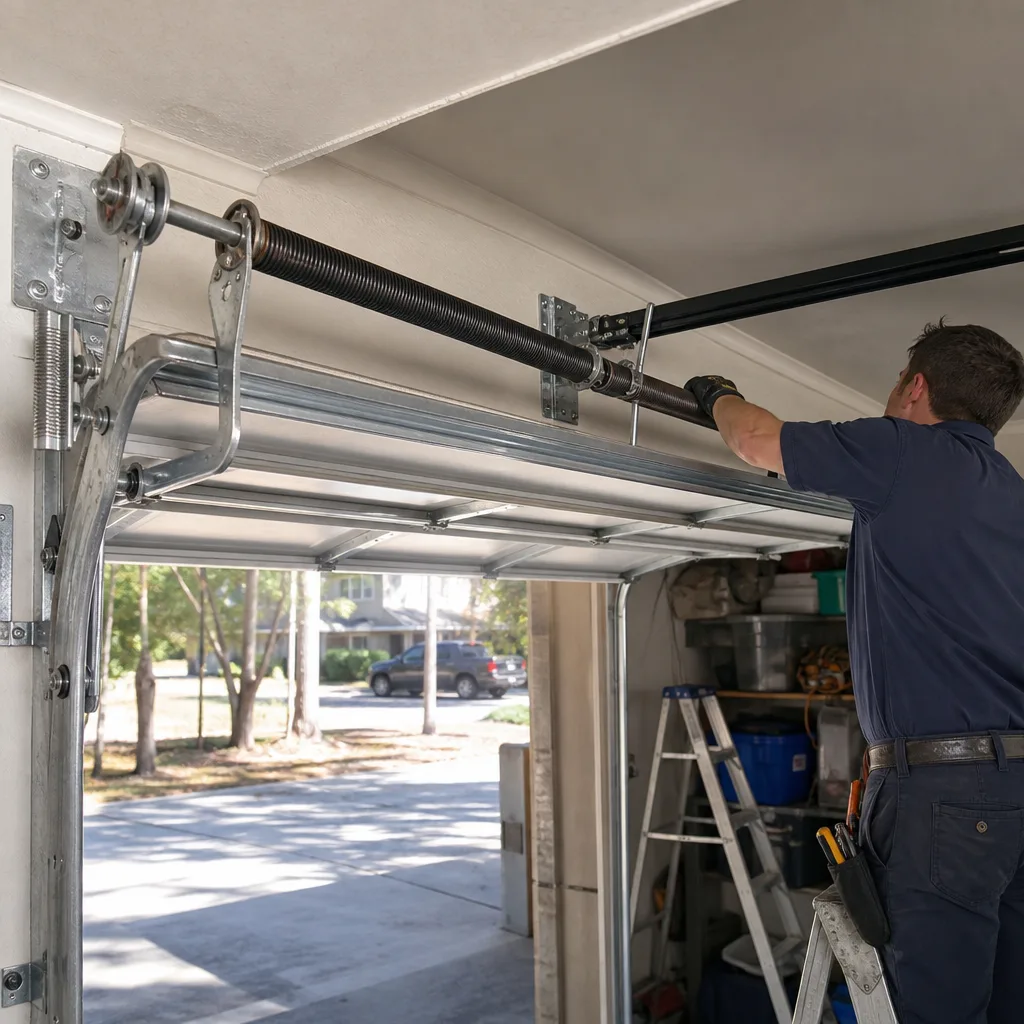
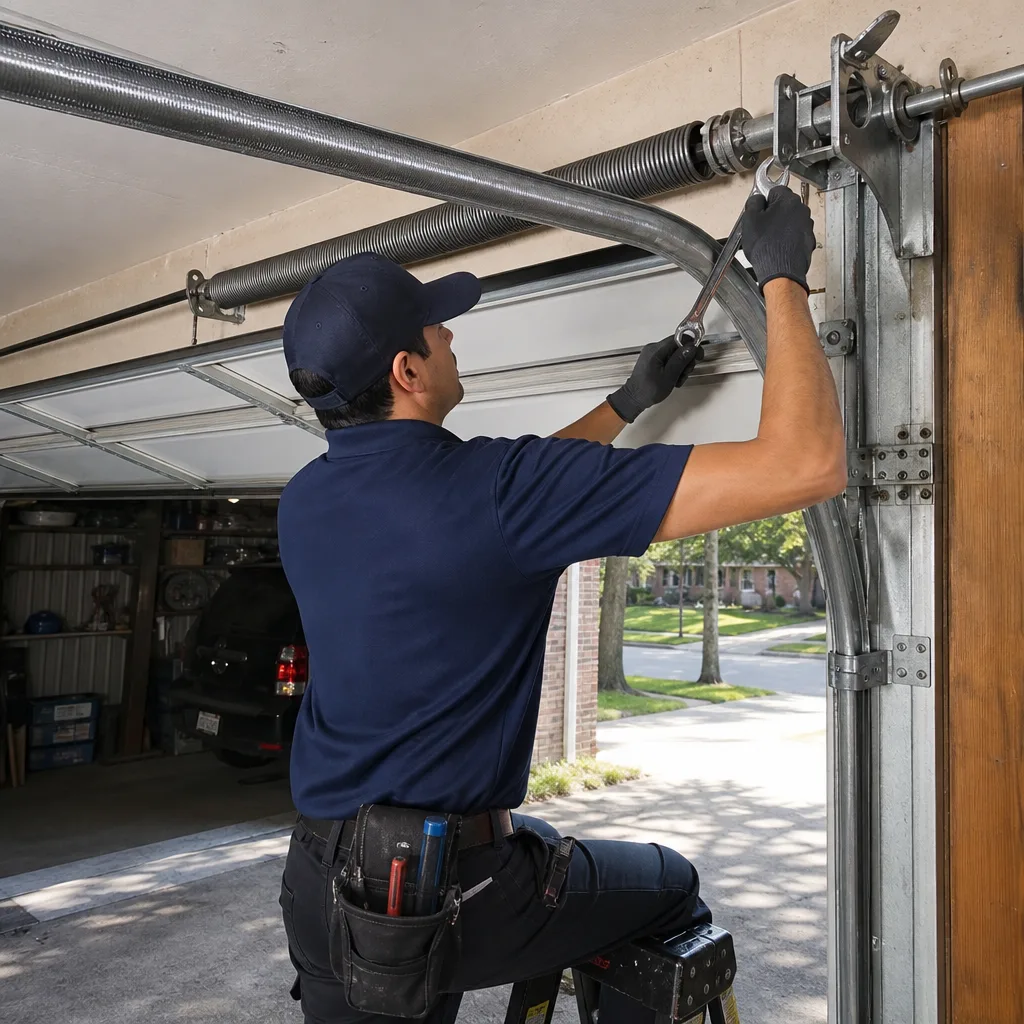
- Torsion spring integrity. Look for a gap in the coil, rust flakes, or a 3-inch or longer stretch between coils when the door is closed. A broken spring transfers full door weight to the opener and cables. The door can slam shut or drop when released.
- Cable condition. Fraying, kinking, or rust staining on the vertical cables that run alongside the door tracks. Even a few broken strands mean the cable is compromised.
- Auto-reverse function. Place a 2×4 board flat on the floor centered under the door. Close the door with the remote. It must reverse within 2 seconds of contact. Test both the contact sensor and the photoelectric eyes.
- Spring anchor and bearing plate. Look for wall flex, pulled lag bolts, or a shifted bearing plate. The spring stores massive torque; if the anchor fails, hardware becomes a projectile.
Safety note: Torsion springs are under extreme tension and can cause severe injury or death if handled improperly. Never attempt to adjust, wind, or release spring tension yourself. This applies to all door types, including garage door repair in The Woodlands for both residential and heavy custom doors.
Tier 2: Operational Efficiency (Failure Causes Premature Wear or Opener Strain)
These affect how long your system lasts and how smoothly it runs. Quarterly attention prevents the slow degradation that leads to emergency calls.
- Roller condition and track alignment
- Hinge bolt tightness
- Weatherstripping seal integrity
- Opener chain or belt tension
- Photo-eye alignment and lens cleanliness
Tier 3: Appearance and Longevity (Failure Affects Curb Appeal and Panel Life)
These protect your investment but do not create immediate operational risk. Annual or as-needed attention.
- Surface cleaning and rust spot treatment
- Paint or finish touch-up on wood or steel panels
- Bottom seal replacement
- Exterior trim and jamb seal inspection
In our experience across The Woodlands, from Panther Creek to Sterling Ridge, the majority of emergency calls we receive could have been prevented with consistent Tier 1 and Tier 2 attention. The homeowner who catches a fraying cable during a monthly visual check-see our Garage Door Warning Signs: A The Woodlands Homeowner’s Reference Guide-avoids the 10 PM call when that cable snaps and the door jams half-open during a thunderstorm.
How The Woodlands Climate Accelerates Wear
The Woodlands sits in a subtropical humidity zone with distinct seasonal patterns that punish garage door components differently than drier climates. Understanding these patterns lets you anticipate problems rather than react to them.
Humidity Indicators to Watch
Surface rust on the bottom panel seam is often the first visible sign that humidity is penetrating your door’s protective coating. In The Woodlands, this typically appears between March and October, when relative humidity stays above 75% for weeks at a time. Check the bottom 6 inches of the interior panel face monthly. Rust here means the factory finish has micro-cracked from thermal expansion, and moisture is wicking into the steel substrate.
Swollen wood trim around the frame signals that humidity is migrating past your weatherstripping. In neighborhoods like Indian Springs and Grogan’s Mill, where mature tree canopy limits air circulation around garages, we see this more frequently than in open-exposure homes. Swollen trim is not cosmetic. It compresses the door seal, creates gaps for insects and water, and eventually rots the jamb.
Opener circuit board corrosion is invisible until the opener behaves erratically. If your LiftMaster or Chamberlain unit starts responding intermittently to remotes, or the wall button requires multiple presses, humidity may have reached the logic board. This is particularly common in garages without climate control, which describes most homes built in The Woodlands before 2005.
Storm and Wind Exposure
The Woodlands experiences severe thunderstorms with straight-line winds exceeding 60 mph several times yearly. After any significant storm, inspect the door from the inside with the garage lights off. Daylight visible around the perimeter means the door has shifted in its tracks or the weatherstripping has compressed. Either condition strains the opener and reduces wind-load resistance.
Horizontal rain during these storms drives water into track bottoms and roller stems. If you hear grinding or squealing that worsens after storms, water has likely washed out existing lubrication and started surface rust on the roller shafts. This is a Tier 2 issue that escalates to Tier 1 if rollers seize and jump the track.
Monthly Checks You Can Do in 10 Minutes
These four checks require no tools beyond a flashlight and a 2×4 board. Do them on the first Saturday of each month. The consistency matters more than perfection.
- Visual spring inspection. With the door closed, stand inside the garage and shine a flashlight across the torsion spring mounted above the door. You are looking for coil gaps, rust powder, or a visible separation. A healthy spring has coils that sit nearly touching when relaxed. If you see daylight between more than a few coils, the spring has lost tension and is working your opener harder than designed. Note what you see, with the date, in a notebook or phone memo.
- Cable scan. Follow each vertical cable from the bottom bracket to the drum above. Fraying looks like a fuzzy texture on the cable surface. Rust staining that runs down the cable indicates internal corrosion. Either condition means the cable is living on borrowed time. Do not operate the door if you find either.
- Auto-reverse test. Place the 2×4 flat on the floor, centered under the door path. Close the door with the remote. The door must reverse immediately on contact. Then, with the door opening, wave your leg through the photoelectric beam. The door must reverse within seconds. If either test fails, discontinue use and call for service.
- Balance check. Disconnect the opener by pulling the red release handle. Manually lift the door to waist height and release. A properly balanced door stays in place or drifts slowly. If it falls closed or shoots upward, the spring tension is incorrect. This is not a DIY adjustment. Reconnect the opener and call a technician.
The balance check reveals something monthly visual inspection cannot: whether the spring is weakening evenly. In The Woodlands, where humidity corrodes springs from the inside out, we see more gradual tension loss than sudden breaks. Catching it early means replacing the spring on your schedule, not during a downpour when the door refuses to open and your car is trapped inside.
Quarterly Maintenance: 30 Minutes of Prevention
Every three months, spend half an hour on tasks that reduce friction, preserve seals, and prevent the small problems that compound into opener failure.
Roller and Track Inspection
With the door closed, inspect each roller for cracks in the wheel, bent stems, or wobble when you manually move the door. Steel rollers rust; nylon rollers crack. Either condition causes the door to bind and the opener to overwork. In The Woodlands, we replace more nylon rollers than steel because UV exposure through garage door windows degrades the plastic faster than humidity attacks steel.
Check track alignment with a visual straightedge. The vertical tracks should be plumb, and the horizontal tracks should angle slightly back toward the motor. Look for dents from vehicle contact, which are common in two-car garages where the center post creates a narrow turning radius. A dented track forces rollers to climb over the deformation, accelerating wear on both components.
Hinge and Hardware Torque
Using a socket wrench, verify that hinge bolts are snug. Do not over-tighten; you are confirming they have not vibrated loose, not applying maximum torque. Loose hinges allow door sections to rack, which strains the opener rail and can cause the door to bind in the tracks. We find loose hardware on roughly one in three doors during service calls in The Woodlands, particularly on doors installed during the 1990s building boom when hardware quality varied.
Weatherstripping and Seal Integrity
Close the door and examine the bottom seal from outside. It should compress evenly across the full width. In The Woodlands, concrete driveways settle over our gumbo clay soils, creating low spots where the seal gaps. A gap of even 1/4 inch admits enough humidity to corrode the bottom panel interior and provides entry for fire ants, which nest in garage door bottom tracks with disturbing frequency.
Check the vinyl or rubber side and top seals for cracking. UV degradation in south-facing garages is severe; we see seal replacement needs in The Woodlands roughly every 4-5 years versus 7-8 years in northern climates.
Photo-Eye Cleaning and Alignment
Wipe the lenses with a soft cloth. Check that both housings are firmly mounted and aligned. A blinking opener light usually indicates misalignment. In our humid environment, condensation inside the housings can cause false obstruction signals. If alignment checks out but the opener still reverses randomly, moisture in the housing is likely.
Annual Tasks Requiring a Professional
Some maintenance is not about homeowner capability. It is about warranty preservation, specialized tooling, and the physical danger of high-tension components. Schedule these annually with a qualified technician.
Spring Tension Measurement and Adjustment
Torsion springs lose approximately 5-10% of their original tension per year through metal fatigue, even without corrosion. A technician measures this with a winding bar and gauge, then adjusts or replaces as needed. In The Woodlands, we recommend annual measurement because humidity corrosion accelerates the fatigue process. A spring that tests at 80% of spec is still functional but overworking your opener and cables. Replacing it before failure is cheaper than replacing the opener it damages.
Full Hardware Torque Verification
Professionals torque hinge and track bolts to manufacturer specification, not just “snug.” They also inspect the lag bolts anchoring the spring bearing plate to the header, which homeowners cannot safely access. In The Woodlands, the expansion and contraction of our humid summers and brief cold snaps loosen these fasteners over time.
Opener Force-Limit Testing and Adjustment
Openers have internal force settings that determine how hard they push before reversing. These drift over time and must be verified with a calibrated gauge. Incorrect settings either cause nuisance reversals or fail to reverse on obstruction, a safety hazard. Genie and LiftMaster units have different adjustment procedures; factory-familiar technicians know the specific sequence for your model.
Cable Drum and Bottom Bracket Inspection
These components are under full spring tension even when the door is closed. A technician inspects for wear patterns that indicate misalignment or impending failure. Homeowners should never touch bottom brackets; the cable attachment points store lethal energy.
When you schedule this annual service, mention any observations from your monthly and quarterly logs. A technician who knows the door has been “making a thump at 3 feet from closed for two months” diagnoses the problem in minutes rather than through elimination. That saves you a return visit and the diagnostic fee that accompanies it.
For annual professional maintenance in our area, garage door repair in The Woodlands from Mainspring includes full spring tension testing, hardware torque verification, and opener safety calibration. We carry the specialized tools and replacement parts on every truck, so most annual service visits are completed without a second trip.
Lubrication Schedule for High-Heat Environments
Standard maintenance advice suggests white lithium grease for garage door components. In The Woodlands, that advice costs homeowners money. Our summer garage temperatures regularly exceed 100°F, and white lithium grease thins and migrates under sustained heat. It drips onto vehicles, attracts dust, and requires reapplication every 6-8 weeks to maintain protection.
What to Use Instead
For roller stems, hinge pins, and bearing plates, we recommend a synthetic garage door lubricant with a temperature stability rating to 350°F. These products contain PTFE or similar compounds that do not thin at high temperatures. They also resist washout during humid periods, which is critical in The Woodlands where morning condensation wets metal surfaces daily.
For the torsion spring itself, use a silicone-based spray lubricant applied lightly. The goal is surface protection against humidity, not heavy coating. Excess lubricant on the spring collects dust and creates an abrasive paste that accelerates wear.
What Never to Lubricate
- The track interior. Rollers need traction, not slip. Lubricated tracks cause rollers to skid and the door to fall out of balance.
- The opener chain or belt. These have factory-applied coatings that last years. Additional lubricant attracts grit and degrades the factory treatment.
- The bottom track or threshold. Any slippery surface here is a safety hazard when stepping in and out of the garage.
Application Schedule
| Component | Product Type | Frequency |
|---|---|---|
| Roller stems and hinges | Synthetic high-temp lubricant | Every 4 months |
| Torsion spring surface | Light silicone spray | Every 6 months |
| Bearing plate and end bearings | Synthetic high-temp lubricant | Annually with professional service |
| Lock mechanism (if present) | Graphite powder | Annually |
In The Woodlands, schedule lubrication for late March and late September. These dates precede our most demanding seasons: summer heat and the tropical storm period. A door lubricated in March has full protection through August. A door lubricated in September is prepared for winter cold snaps and spring humidity.
How to Log Observations and Save on Diagnostic Calls
Intermittent garage door problems are the most expensive to diagnose. A door that reverses randomly, or makes a noise only on Tuesday mornings, gives a technician almost nothing to work with unless you have documented patterns. A simple log transforms guesswork into targeted repair.
What to Record
For any observation, note: date, time, weather conditions, what the door was doing, and what you did. Example: “June 14, 8:15 AM, 78°F and foggy, door reversed 2 feet from closed, pressed remote again and it closed normally.” This tells a technician that humidity may be affecting the photo-eye or that the close-force limit is set too sensitively for morning conditions when lubricant is coolest and thickest.
Photo Documentation
Photograph any rust, fraying, or misalignment monthly, even if it looks unchanged. Comparing photos over time reveals progression that casual observation misses. A cable that looks identical to your eye may show 20% more fraying when compared to a photo from three months prior. That progression rate tells a technician whether replacement is urgent or can wait until your scheduled annual service.
How This Saves Money
A technician presented with six months of logs can often diagnose an intermittent problem in 15 minutes. Without logs, the same problem may require two or three visits with different hypotheses, each billed separately. In The Woodlands, where our summer storm season creates power fluctuations that affect opener behavior, logs that note “problem only after outage” versus “problem regardless of weather” eliminate half the diagnostic possibilities immediately.
We have seen homeowners in Cochran’s Crossing and Alden Bridge reduce their average repair invoice by 30-40% simply by keeping a dated notebook in the garage and recording observations as they happen. The practice costs nothing and takes less time than most people spend choosing a streaming show.
Which DIY Repairs Void Your Manufacturer Warranty
Every major brand, including the garage door opener in The Woodlands systems we service from LiftMaster, Chamberlain, Genie, and Raynor, carries warranty language that excludes coverage after certain homeowner actions. Understanding these exclusions prevents you from inadvertently converting a free warranty repair into a full-cost replacement.
Universal Warranty Voids
Torsion spring adjustment or replacement by non-professionals. This is the most common and most expensive void. All manufacturers require spring work by a certified or licensed technician. The language is explicit: “Warranty void if spring system is modified by unauthorized personnel.” The reason is liability, not protectionism. Incorrectly wound springs damage door sections, opener rails, and vehicles, and manufacturers do not want responsibility for homeowner injury.
Opener force-limit adjustment without calibrated tools. LiftMaster and Chamberlain warranties specifically exclude opener damage caused by incorrect force settings. Homeowners who turn the adjustment dials to “fix” a reversing problem, rather than addressing the underlying mechanical issue, often burn out the motor. That damage is not covered.
Use of non-specified lubricants or solvents. WD-40 is the most common culprit. It is a solvent, not a lubricant, and it strips the protective coatings that manufacturers apply to springs and bearings. Using it voids component warranties. Similarly, heavy grease in tracks voids roller warranties by causing flat spots and premature wear.
Panel modification or drilling. Adding decorative hardware, windows, or insulation to factory panels without manufacturer approval voids the panel warranty. The structural calculations assume original weight distribution. Even small changes alter wind-load ratings and stress points.
Brand-Specific Variations
Raynor warranties require annual professional maintenance records for commercial doors and strongly recommend them for residential. Genie opener warranties require registration within 30 days of installation; failure to register shortens the warranty period by half. LiftMaster’s MyQ-enabled openers have separate warranty terms for the electronic components that differ from the mechanical drive system.
If you are uncertain about your warranty status, we provide free documentation review with any service call. We have encountered homeowners in The Woodlands who believed their door was out of warranty when it was fully covered, and others who assumed coverage existed after actions that voided it years before. Knowing where you stand prevents surprises on the bill.
Common Mistakes to Avoid
- Treating all maintenance as equally urgent. A dirty door panel does not deserve the same attention as a fraying cable. Rank your tasks by consequence, or you will spend Saturday washing the door while a failing spring goes unobserved.
- Using WD-40 on any garage door component. It is a solvent that removes existing lubrication and attracts dust. In The Woodlands humidity, the resulting paste accelerates wear faster than no lubrication at all.
- Ignoring seasonal patterns. A door that behaved normally through winter may develop problems in March when humidity rises. Do not dismiss spring behavior changes as random; they are often the first sign of humidity damage.
- Testing the auto-reverse with a hand or foot instead of a solid object. The safety standard specifies a 2×4 board because it simulates a rigid obstruction. A soft hand or shoe does not test the force limit accurately and risks injury if the system fails.
- Attempting to “tighten” a torsion spring by turning set screws. Set screws lock the spring to the shaft; they do not adjust tension. Turning them without proper winding bars and training is extremely dangerous and voids every warranty.
- Skipping the balance check because the opener “still works.” An opener lifting an unbalanced door is working at 150-200% of design load. It will fail prematurely, and that failure is not covered under opener warranty because the root cause is door maintenance, not opener defect.
- Calling for emergency service without basic information. Know your door’s approximate age, brand if visible, and whether the problem is sudden or gradual. This information lets the dispatcher send the right technician with the right parts, which matters in The Woodlands where some neighborhoods have 30-minute drive times during rush hour.
When to Call a Professional
Call a technician immediately if your monthly check reveals spring gaps, cable fraying, or auto-reverse failure. Do not operate the door. These are not maintenance items; they are active safety hazards.
Call for scheduled service if your quarterly inspection finds loose track mounting, worn rollers, or deteriorating weatherstripping. These are preventable problems that become emergency calls if deferred.
Call for annual professional maintenance to preserve warranty coverage, verify spring tension, and catch the subtle wear patterns that homeowner inspection misses. A technician sees hundreds of doors annually and recognizes failure modes that do not appear in any checklist.
Mainspring Garage Door Co. offers free estimates in The Woodlands. Carl Dutton and our team have served this community since 2016, and we answer the phone live at (346) 682-0797, including nights, weekends, and holidays. Our trucks carry springs, cables, openers, and hardware for all major brands, so most jobs are completed in a single visit. Every repair is covered by our 90-Day Done Right Promise, stated in writing: if it is not right, we return at no charge, no paperwork, no arguing.
For new door considerations or full system replacement, we also provide garage door installation in The Woodlands with the same upfront pricing and written guarantee.
Frequently Asked Questions
Monthly safety checks, quarterly operational maintenance, and annual professional service are the minimum for The Woodlands’ humid climate. The humidity accelerates corrosion and lubricant breakdown compared to drier regions, so the standard “twice yearly” advice found in generic guides is insufficient here. Call (346) 682-0797 to schedule annual professional maintenance with a technician who understands local conditions.
Professional annual maintenance typically ranges from $89 to $150, depending on door size and opener complexity. Mainspring’s $89 Seasonal Tune-Up includes full safety inspection, spring tension test, hardware torque verification, and lubrication with high-temperature-rated products formulated for our climate. Repairs found during maintenance are quoted upfront before any work begins. Call (346) 682-0797 for exact pricing on your specific door.
No. Monthly visual checks, photo-eye cleaning, and weatherstripping inspection are appropriate homeowner tasks. Torsion spring adjustment, cable replacement, opener force-limit calibration, and bottom bracket work require specialized training and tools, and incorrect DIY work voids manufacturer warranties and risks serious injury. A sensible maintenance program combines homeowner observation with professional service for high-risk components.
Heat thins lubrication and expands metal components, increasing clearance and allowing more movement in hinges and rollers. In The Woodlands, humidity also causes minor rust on roller stems that grinds until the lubricant is refreshed. If noise persists after proper lubrication, it often indicates worn rollers or loose hardware that needs professional attention. Note the specific conditions when noise occurs in your maintenance log for faster diagnosis.
Routine homeowner maintenance, including lubrication and visual inspection, does not void warranties. However, using incorrect products (WD-40, heavy grease in tracks), adjusting springs or cables, or modifying panels without approval voids coverage on affected components. When in doubt, document what you did and with what products, and consult a professional before proceeding with anything beyond basic inspection and cleaning.
Disconnect the opener and manually lift the door to waist height. A balanced door stays in place or drifts very slowly. If it falls closed or rises rapidly, the spring tension is incorrect. Do not attempt to adjust this yourself. Note the behavior in your log and call for service. An unbalanced door overworks the opener and will cause premature failure that is not covered under opener warranty.
The Bottom Line
Effective garage door maintenance in The Woodlands requires distinguishing safety-critical inspection from routine upkeep, respecting the climate factors that accelerate wear, and knowing which tasks protect your warranty versus which void it. The homeowner who spends ten minutes monthly on Tier 1 checks, thirty minutes quarterly on Tier 2 maintenance, and schedules annual professional service avoids the emergency calls that disrupt life and cost significantly more than prevention. Keep a dated log of observations. Use lubricants rated for high-heat humidity. And never risk injury or warranty coverage by attempting work on high-tension components. The door will run quieter, last longer, and never trap your vehicle when you need it most.
Written by Carl Dutton, Owner at Mainspring Garage Door Co., serving The Woodlands since 2016.