
Last updated September 10, 2026
Full 25-point door and opener safety check with every visit - springs, cables, rollers, tracks, and your LiftMaster or Chamberlain opener included
You get a price before we start. It does not change when the truck arrives.
 Before
 After
After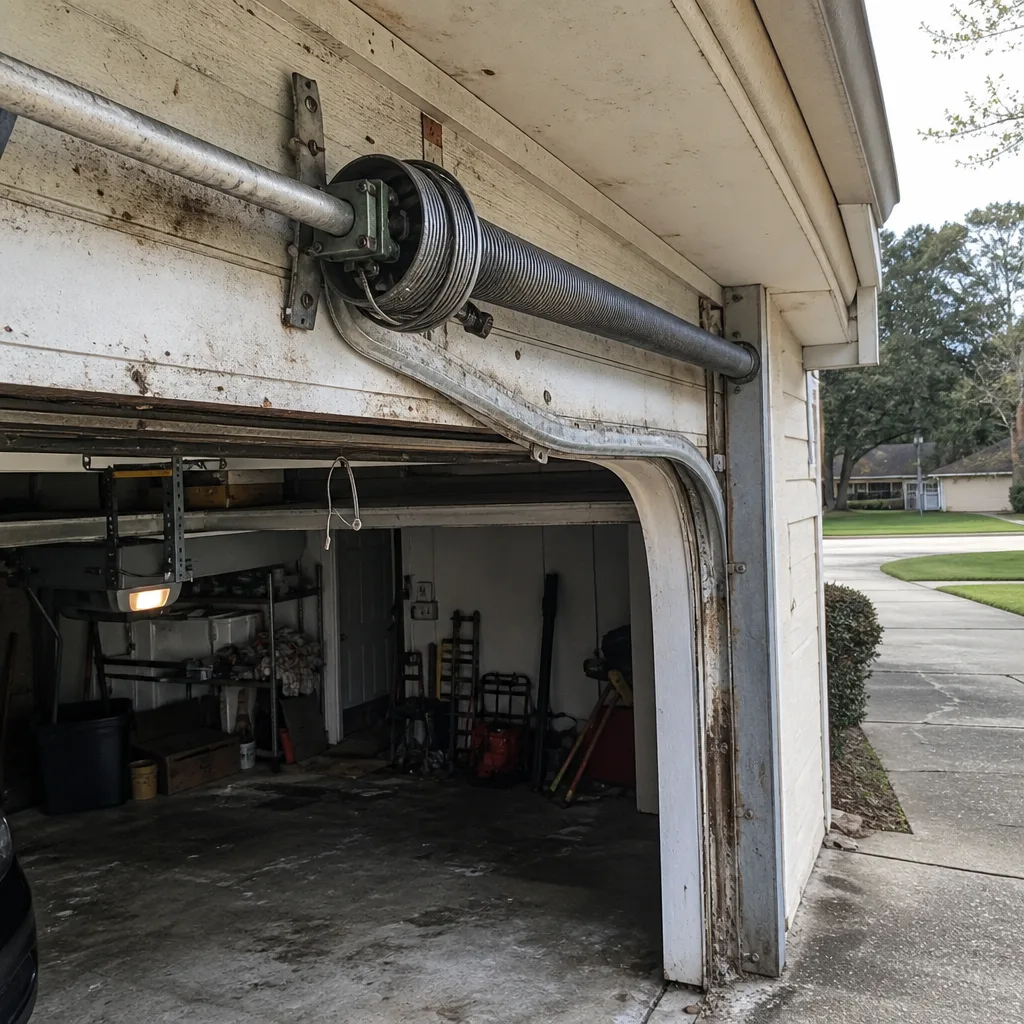 Before
 After
After Before
 After
AfterGarage Door Permits, Codes & Inspections in TX: What You Need to Know
A garage door replacement does not always require a permit in Texas - but if yours does and you skip it, your homeowner’s insurance carrier has grounds to deny a related structural claim. That is a risk most homeowners in The Woodlands are unaware they are taking. In this guide, we’ll walk you through exactly when permits are required, how to determine which county has authority over your address, what wind-load ratings mean for your purchase, and why the paperwork you keep today protects your home sale tomorrow. For more guides & resources, visit our blog.
Quick Answer
Most garage door replacements in The Woodlands do not require a municipal permit if the work is a like-for-like swap with no structural changes. However, new construction, alterations to the opening size, or any work affecting the home’s wind-load envelope will trigger permitting in both Montgomery County and Harris County jurisdictions. When a permit is required, it must be obtained before work begins, the installation must pass inspection, and the final documentation should be filed with your homeowner’s insurance and kept for the life of your ownership.
Table of Contents
- How to Determine Your County Jurisdiction in The Woodlands
- Replacement vs. New Construction: The Permit Threshold
- Wind-Load Ratings: What Texas Requires and Why It Matters
- HOA Architectural Review Is Not a Permit
- What to Expect During Inspection
- Documentation to Keep and Why It Matters at Sale
- Common Mistakes to Avoid
- When to Call a Professional
- Frequently Asked Questions
How to Determine Your County Jurisdiction in The Woodlands
The Woodlands spans two counties, and the line runs through neighborhoods most residents assume are governed by a single authority. Your permit requirements, fee schedules, and inspection protocols depend entirely on which side of that line your property sits.
Montgomery County covers the eastern and northern portions of The Woodlands, including the villages of Sterling Ridge, Panther Creek, and parts of Indian Springs. Harris County covers the southern and western areas, including Grogan’s Mill, Cochran’s Crossing, and portions of Alden Bridge. The boundary roughly follows the San Jacinto River watershed, but the actual line cuts through developed neighborhoods in ways that surprise longtime residents.
Here is how to confirm your jurisdiction with certainty:
- Check your property tax statement. The taxing authority listed - Montgomery County or Harris County - indicates which municipal code applies to your address.
- Verify through the Montgomery County Engineer’s Office or Harris County Public Infrastructure Department using your street address. Both maintain online lookup tools.
- Call your HOA management company if you are in an active village association. They maintain jurisdiction maps for their boundaries.
- Ask your garage door contractor before quoting the job. A company that works regularly in The Woodlands, like Mainspring Garage Door Co., will know the boundary and which permits apply.
The practical difference matters. Montgomery County typically requires permits for new construction and structural alterations but exempts like-for-like replacements. Harris County has historically been more restrictive in unincorporated areas, though recent streamlining has narrowed the gap. Neither county requires a homeowner to pull the permit personally - a licensed contractor can do so on your behalf, and most do as standard practice.
In our 42 years of serving this area, we’ve arrived at homes where the owner was certain they lived in Montgomery County only to discover their address fell under Harris County permitting. The reverse happens just as often. Guessing wrong means a stop-work order, a re-inspection fee, and a delayed project. We verify jurisdiction before we quote.
Replacement vs. New Construction: The Permit Threshold
Texas operates under a permissive statewide building code framework, which means the Texas Department of Licensing and Regulation does not mandate uniform garage door permitting. Individual municipalities and counties set their own thresholds. Understanding where your project falls on the replacement-to-new-construction spectrum determines whether you need to engage the permitting process at all.
Like-for-like replacement - removing an existing door and installing a new one of the same dimensions, without modifying the header, jambs, or opening - generally does not require a permit in Montgomery County or Harris County. This covers the majority of garage door replacements we perform in The Woodlands. The work is considered maintenance or repair, not construction.
Structural alteration - widening the opening, raising the header height, converting a single door to a double, or any modification to the load-bearing frame - triggers permitting in both counties. The garage door opening is part of your home’s structural envelope. Altering it without engineering review risks compromising the wall’s integrity, especially in wind-load zones.
New construction - any door installed in a newly built garage or an addition - always requires a permit and inspection. This includes detached garage builds, which have become more common in The Woodlands as homeowners add workshop space or ADUs to their properties.
Opener installation and electrical work present a separate layer. Hardwiring a new opener circuit or adding electrical outlets in the garage may require an electrical permit even when the door itself does not. Montgomery County and Harris County both treat this as distinct from the door permit, and it must be performed by a licensed electrician or a contractor holding the appropriate electrical endorsement.
The threshold that catches homeowners off guard is the wind-load envelope. If your replacement door has a different wind-load rating than the original - even at the same dimensions - some inspectors interpret this as altering the home’s engineered resistance. We address wind-load specifically in the next section because it has become the most common source of permit disputes in The Woodlands.
Wind-Load Ratings: What Texas Requires and Why It Matters
Texas adopted wind-load provisions from the International Residential Code that apply to garage doors based on size, location, and exposure. The Woodlands sits in a region where design wind speeds reach 120 mph in open terrain, though most residential areas qualify for reduced exposure ratings due to tree cover and neighboring structures.
A wind-load rating measures the pressure a door can withstand without failing. The rating is expressed in pounds per square foot (psf) and must be marked on a label affixed to the door itself. For a standard 16-foot by 7-foot door in The Woodlands, the typical requirement is 20 psf, though homes on golf course lots, corner lots, or elevated terrain may require 25 psf or higher.
Here is what the rating means in practical terms:
- 20 psf - withstands winds typical of most Woodlands neighborhoods with standard tree coverage and adjacent homes.
- 25 psf - required for larger openings, corner lots, or homes with significant exposure to open terrain.
- 30+ psf - typically for coastal and high-wind zones, rarely required in The Woodlands but relevant for homes near Lake Woodlands or on elevated lots.
The critical step most homeowners miss: confirming the rating before purchase. A door may be marketed as “wind-rated” without specifying the psf value. The label must match or exceed your home’s engineered requirement. If you are replacing a door that was installed under earlier code cycles, the new door must meet current standards, not the standard from when the home was built.
Major manufacturers publish wind-load documentation. Clopay and Amarr both provide county-specific compliance letters upon request. Wayne Dalton includes wind-load labels on all models rated for Texas markets. We carry these documents on our trucks because inspectors in both Montgomery and Harris counties have begun asking for manufacturer certification during final inspection.
Carl Dutton, our owner, has seen the consequence of mismatched ratings firsthand. A Grogan’s Mill homeowner purchased a door online that was wind-rated for interior states. When the county inspector checked the label, the rating was 15 psf - below the 20 psf requirement. The door had to be removed and replaced. The homeowner paid twice. We quote only doors that carry verified ratings for your specific address, and we show you the label before we hang it.
HOA Architectural Review Is Not a Permit
Every village in The Woodlands operates under a homeowners association with architectural control guidelines. These govern color, style, window placement, and material - but they do not replace municipal permitting. The two processes run on separate tracks, and satisfying one does not satisfy the other.
The correct order matters. Architectural review must typically be completed before permit application, because the approved design becomes part of the documentation submitted to the county. Reversing the sequence means paying permit fees twice if the HOA rejects your door selection.
Most Woodlands HOAs require:
- A completed architectural modification application, often with a photo or rendering of the proposed door.
- Color samples or manufacturer specifications showing compliance with village palette restrictions.
- Payment of a review fee, typically $25-$75 depending on the village association.
- A waiting period of 10-30 days for committee review.
Some villages, particularly in Sterling Ridge and Indian Springs, maintain pre-approved door styles and colors that expedite review. Others, including portions of Panther Creek, require individual review for any change. Your property management company can provide the specific requirements and timeline.
We coordinate with HOA offices regularly. When we quote a garage door installation in The Woodlands, we ask about your village’s process and build that timeline into our schedule. A permit pulled before HOA approval is a permit wasted. A door installed without HOA approval is a violation that can trigger fines and forced removal.
The Woodlands Township also maintains a separate set of standards for commercial properties and certain mixed-use developments. If your home fronts a major thoroughfare like Woodlands Parkway or Research Forest Drive, additional signage or visibility restrictions may apply. We account for these in our planning.
What to Expect During Inspection
When a permit is required, the installation must pass inspection before the permit can be closed. Understanding what the inspector checks helps you prepare and ensures the work is done correctly the first time.
Structural inspection verifies that the opening, header, and framing remain intact and properly supported. The inspector will check that no load-bearing members were cut or notched during installation, that the header size matches the span, and that king studs and jack studs are in place. For retrofits, this is usually straightforward. For alterations, the inspector may require an engineer’s letter confirming the modified opening meets code.
Door operation inspection confirms the door opens and closes smoothly, that safety reverse mechanisms function, and that the opener - if present - meets current UL 325 standards. The inspector will test the photoelectric sensors and the force-setting sensitivity. Doors installed without openers are checked for manual operation and balance.
Wind-load verification has become standard in both Montgomery and Harris counties. The inspector reads the label on the door or requests manufacturer documentation. We attach a copy of the compliance letter to the permit packet to avoid delays.
Final inspection scheduling varies by county workload. Montgomery County typically offers next-day or two-day availability. Harris County can run three to five days during peak construction season. Both counties allow the contractor to schedule online or by phone. We schedule the inspection as part of our project management - you do not need to be present if we have access to the garage.
If the installation fails inspection, the inspector issues a correction notice with specific items to address. Common failures include missing wind-load documentation, improper sensor height, or opener force settings outside tolerance. We correct and reschedule at no additional charge under our 90-Day Done Right Promise. In 42 years, we have learned what inspectors look for and build to that standard from the first measurement.
Documentation to Keep and Why It Matters at Sale
The permit file, inspection approvals, manufacturer warranties, and installation records form a paper trail that protects your investment and simplifies your home sale. Homeowners who discard this paperwork create problems that surface years later.
Keep these documents permanently:
- The permit application and approval, including the permit number and issue date.
- The final inspection approval or certificate of completion.
- The manufacturer’s wind-load compliance letter and product label photograph.
- The installation invoice with itemized scope of work.
- Warranty documents for the door, opener, and installation labor.
When you sell your home, the buyer’s inspector and title company will ask about permitted work. Unpermitted structural alterations must be disclosed on the seller’s disclosure in Texas. If the buyer discovers unpermitted work after closing, they may have grounds for legal action. A clean permit history removes this liability entirely.
Insurance claims present the more immediate risk. If a storm damages your garage and the adjuster finds unpermitted structural work, the carrier may deny the claim or reduce the payout. We have seen this in The Woodlands after spring storm seasons, when carriers scrutinize damage more closely. The permit documentation proves the work was code-compliant and professionally installed.
We provide every customer with a completed job packet that includes all relevant documentation. For permitted work, we also file copies with the appropriate county office to ensure the record exists independently of your files. This is standard practice at Mainspring, not an add-on service.
Common Mistakes to Avoid
- Assuming The Woodlands is a single jurisdiction. Montgomery County and Harris County have different fee schedules, inspection protocols, and interpretation of replacement thresholds. Verify before you start.
- Treating HOA approval as a permit substitute. The architectural committee governs aesthetics. The county governs structure and safety. Both must be satisfied, in that order.
- Buying a door based on price without checking the wind-load label. A door that fails inspection costs more than a compliant door purchased correctly the first time. The label is not optional decoration.
- Letting a contractor skip the permit to save time. Unpermitted work voids protections. If the contractor disappears, you bear the cost of correction and the legal exposure.
- Discarding paperwork after installation. The documents you need most are the ones you will not think about for ten years. File them with your deed or homeowner’s insurance policy.
- Ignoring the electrical permit for opener work. A new circuit or outlet in the garage requires separate electrical permitting even when the door itself does not. This is the most common secondary violation we encounter.
When to Call a Professional
Permit research, jurisdiction verification, and code compliance are not homeowner tasks. The consequences of error - failed inspection, insurance denial, HOA violation - exceed the cost of professional handling. A qualified garage door contractor in The Woodlands should verify your jurisdiction, confirm permit requirements, pull permits when needed, schedule inspections, and deliver complete documentation. Learn How to Hire a Garage Door Contractor in The Woodlands: A Step-by-Step Guide to ensure you choose the right professional.
Mainspring Garage Door Co. offers free estimates in The Woodlands - call (346) 682-0797. We determine permit requirements before we quote, pull permits as part of our standard process, and provide complete documentation on every job. Our trucks carry Clopay, Amarr, and Wayne Dalton doors with verified wind-load ratings for your specific address. Most installations are completed in a single visit, and every job is backed by our 90-Day Done Right Promise in writing.
Frequently Asked Questions
A like-for-like replacement of an existing garage door typically does not require a permit in Montgomery County or Harris County. However, if you are altering the opening size, converting from single to double doors, or installing in new construction, permitting is required. Call us at (346) 682-0797 and we will verify your specific address and project scope at no charge.
Check your property tax statement for the taxing authority, or use the online address lookup tools maintained by the Montgomery County Engineer’s Office and Harris County Public Infrastructure Department. Your HOA management company also maintains jurisdiction maps. We verify this for every customer before quoting.
Most homes in The Woodlands require a 20 psf wind-load rating for standard residential doors. Homes on corner lots, golf course lots, or elevated terrain may require 25 psf. The rating must be verified on the manufacturer’s label before purchase. We confirm this rating for every door we quote and show you the documentation before installation begins.
Your HOA cannot stop you from maintaining your home, but it can enforce architectural guidelines on color, style, and material. Approval must be obtained before installation in most Woodlands villages. Installing without approval can result in fines and required removal. We guide our customers through this process as part of our standard service.
If the installation required a permit and none was obtained, your insurance carrier may deny structural damage claims related to the door or opening. This is particularly relevant after storm events. We pull permits when required and provide documentation that supports your coverage.
HOA architectural review typically takes 10-30 days. Montgomery County permits are often issued same-day or next-day, with inspection available within 1-2 days. Harris County may take 3-5 days for inspection scheduling during peak season. We build these timelines into our project schedule and handle all coordination.
The Bottom Line
Garage door permitting in The Woodlands is not complicated, but it is specific. Your county jurisdiction, your project’s scope, and your door’s wind-load rating determine whether a permit is required and what documentation you must maintain. Skipping steps to save time risks insurance denial, inspection failure, and complications at home sale. The square deal is to verify requirements upfront, complete the work to code, and keep the paperwork. That is how we have operated since 1984, and it is how we protect every customer we serve.
Written by Carl Dutton, Owner at Mainspring Garage Door Co., serving The Woodlands since 2016.