
Last updated September 10, 2026
Full 25-point door and opener safety check with every visit - springs, cables, rollers, tracks, and your LiftMaster or Chamberlain opener included
You get a price before we start. It does not change when the truck arrives.
 Before
 After
After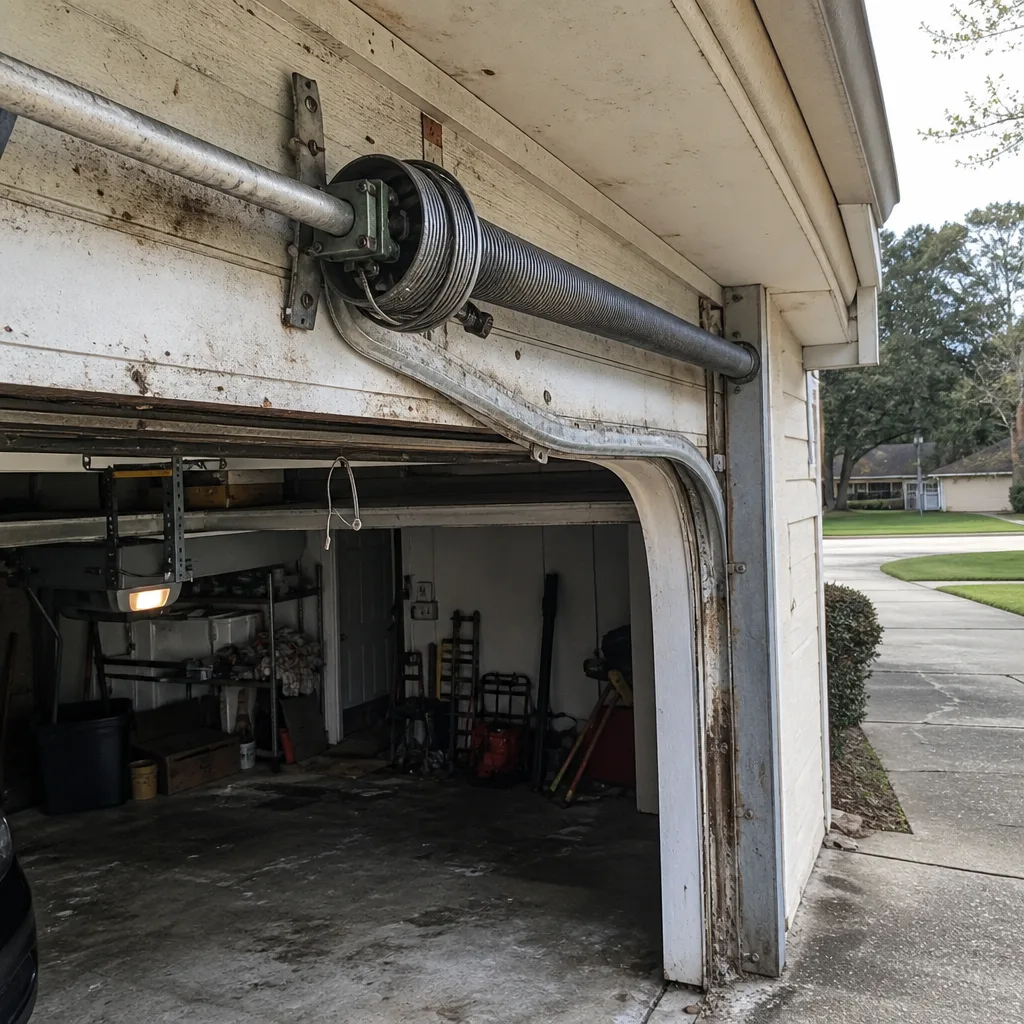 Before
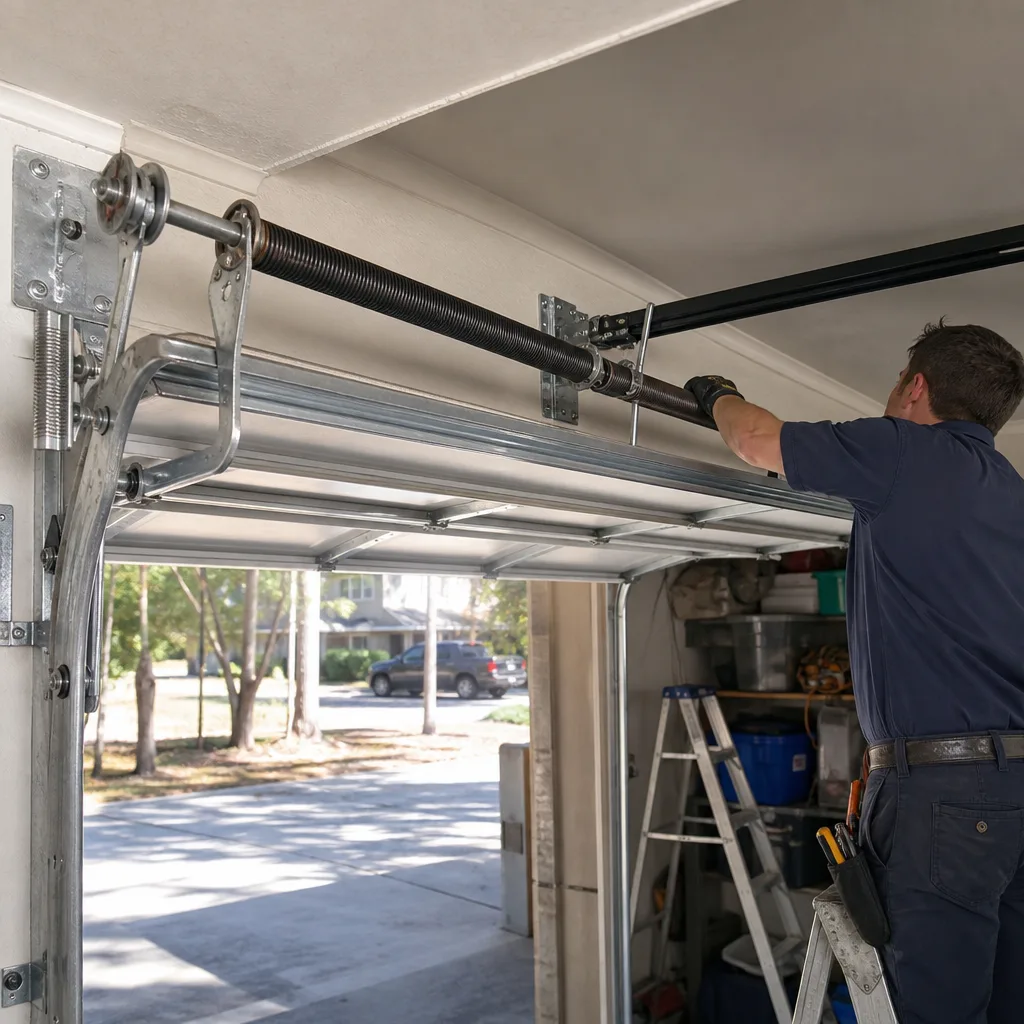 After
After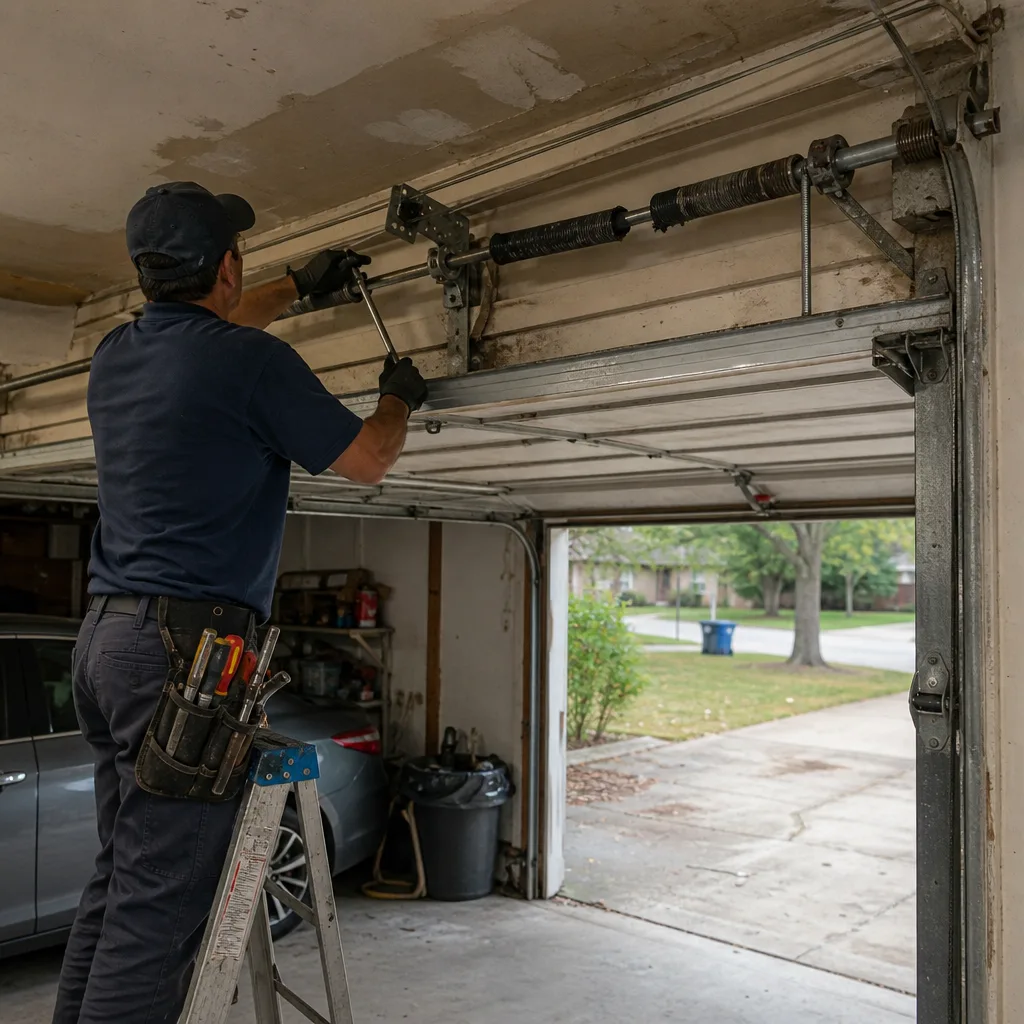 Before
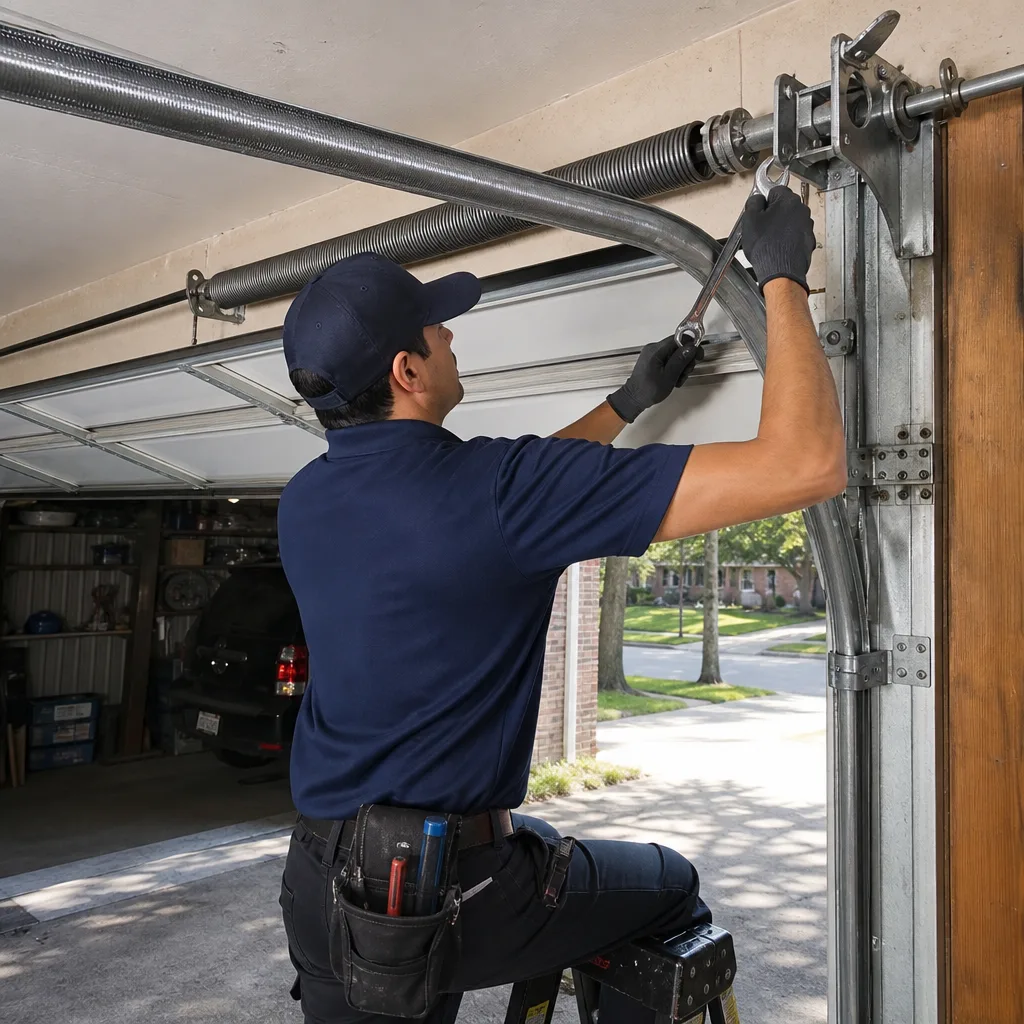 After
AfterDIY vs Professional Garage Door: The The Woodlands Homeowner’s Decision Guide
A torsion spring on a standard residential garage door stores roughly 10,000 foot-pounds of torque. When it releases unexpectedly, that energy can break a wrist, fracture a forearm, or send a winding bar through drywall. In The Woodlands, where summer humidity swells wooden doors and winter cold contracts metal tracks, the question is not whether you are handy enough to fix your own garage door. It is whether you can tell the difference between a task that costs you an hour on a Saturday and one that costs you a trip to the emergency room. This guide draws a clear line. We will walk through what you can safely handle yourself, what requires a trained technician, what the tools actually cost, and how the Texas heat and local building conditions change the math. For Garage Door Cost Breakdown: The The Woodlands Homeowner’s Reference for 2026, see our dedicated pricing guide.
Quick Answer
Homeowners in The Woodlands can safely perform basic maintenance, remote programming, sensor cleaning, and bottom seal replacement. Any work involving torsion springs, lift cables, or track realignment should be handled by a professional with proper tools and training. The cost of renting or buying the specialized equipment for spring replacement typically exceeds the labor cost of hiring a technician, and the injury risk is severe.
Table of Contents
- Where the Danger Lives: The Task-by-Task Matrix
- What You Can Safely Do Yourself
- What Belongs to a Professional
- The Real Cost Comparison: Tools vs. Labor
- How The Woodlands Conditions Affect Your Door
- DIY Repairs, Warranty, and Texas Resale Disclosures
- Common Mistakes to Avoid
- When to Call a Professional
- Frequently Asked Questions
- The Bottom Line
Where the Danger Lives: The Task-by-Task Matrix
The garage door is the largest moving object in most homes. It is also a counterweighted system, which means every component depends on every other component. When you understand which parts carry lethal tension and which do not, the DIY decision becomes mechanical, not emotional.
Here is how we break it down after 42 years in this trade.
Safe for Most Homeowners
- Lubrication of rollers, hinges, and the opener rail
- Photo-eye sensor cleaning and realignment
- Remote control and keypad programming
- Bottom weather seal replacement
- Visual inspection for worn cables or rust
- Testing auto-reverse function
Requires Professional Tools and Training
- Torsion or extension spring replacement
- Lift cable replacement or reattachment
- Track bending, realignment, or replacement
- Bottom bracket replacement (where cables attach)
- Panel replacement on sectional doors
- Opener motor gear replacement
The dividing line is tension. Springs and cables are under constant load, even when the door appears still. Rollers, hinges, and seals carry no load beyond the weight of the door section they touch. That distinction is everything.
In Panther Creek and Indian Springs, we have seen experienced DIYers replace a bottom seal in twenty minutes and do a clean job. We have also seen the same homeowners attempt cable replacement and end up with a door off both tracks, bent panels, and a $400 repair that would have cost $180 if they had called first.
What You Can Safely Do Yourself
These tasks require no special tools beyond a stepladder, a clean rag, and a basic socket set. They will keep your door running quiet and extend its service life.
Lubrication
Use a silicone-based spray or white lithium grease on metal-to-metal contact points. In The Woodlands, avoid WD-40 as a primary lubricant. It is a solvent, not a lubricant, and the summer heat burns it off within weeks. We see this mistake in Alden Bridge every July. Hit the hinges, roller bearings, and the opener rail. Do not lubricate the track itself. The rollers need friction to roll, not slide.
Sensor Cleaning and Alignment
The photo eyes sit four to six inches off the floor on either side of the door. Clean the lenses with a dry cloth. Check that both units show a solid LED light, not blinking. If one blinks, loosen the wing nut, adjust until both LEDs glow steady, and retighten. In Grogan’s Mill, where slab settlement is common, we find sensors knocked out of alignment by lawn equipment or by the slab itself tilting slightly over decades.
Remote Programming
This is the one scenario where DIY is clearly the right call. Most openers manufactured after 1993 use a learn button on the motor housing.
- Locate the learn button on the opener motor. It is usually purple, red, or yellow, square or circular, behind the light lens.
- Press and release the learn button. The indicator LED will glow for thirty seconds.
- Within thirty seconds, press and hold the button on your remote that you want to program.
- The opener lights will flash, or you will hear two clicks. Release the remote button.
- Test the remote.
For Chamberlain and LiftMaster openers with MyQ, the process differs slightly. Hold the learn button until the LED turns off, then follow the app prompts. Genie openers use a similar learn-button method but often require pressing the remote button twice. Consult your owner’s manual for the specific sequence.
Bottom Seal Replacement
Remove the old seal by pulling it from the retainer channel. Clean the channel with a wire brush. Thread the new seal through, working from one end. A dab of dish soap helps it slide. This is a thirty-minute job that saves you a service call.
What Belongs to a Professional
Spring replacement is the task most homeowners consider doing themselves. It is also the task most likely to cause serious injury. Here is why.
Torsion Springs: The Mechanical Reality
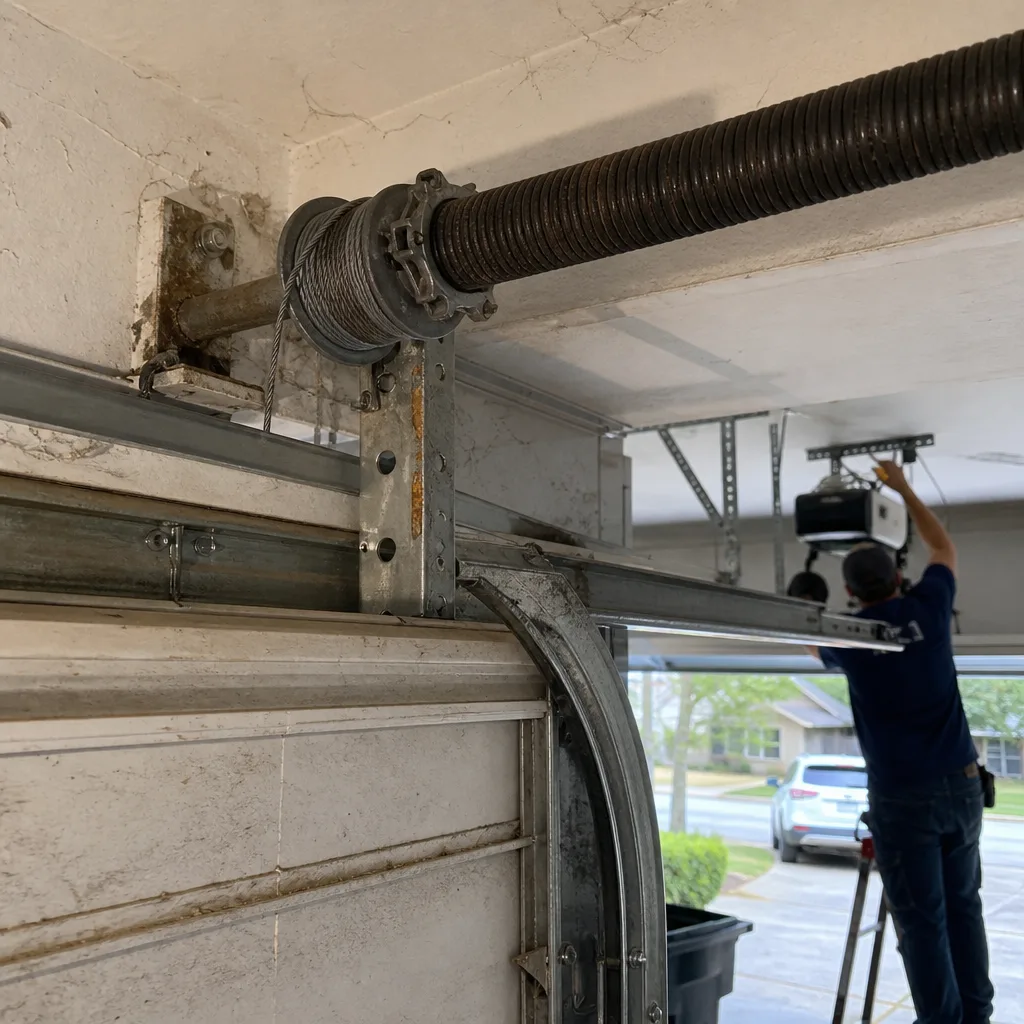
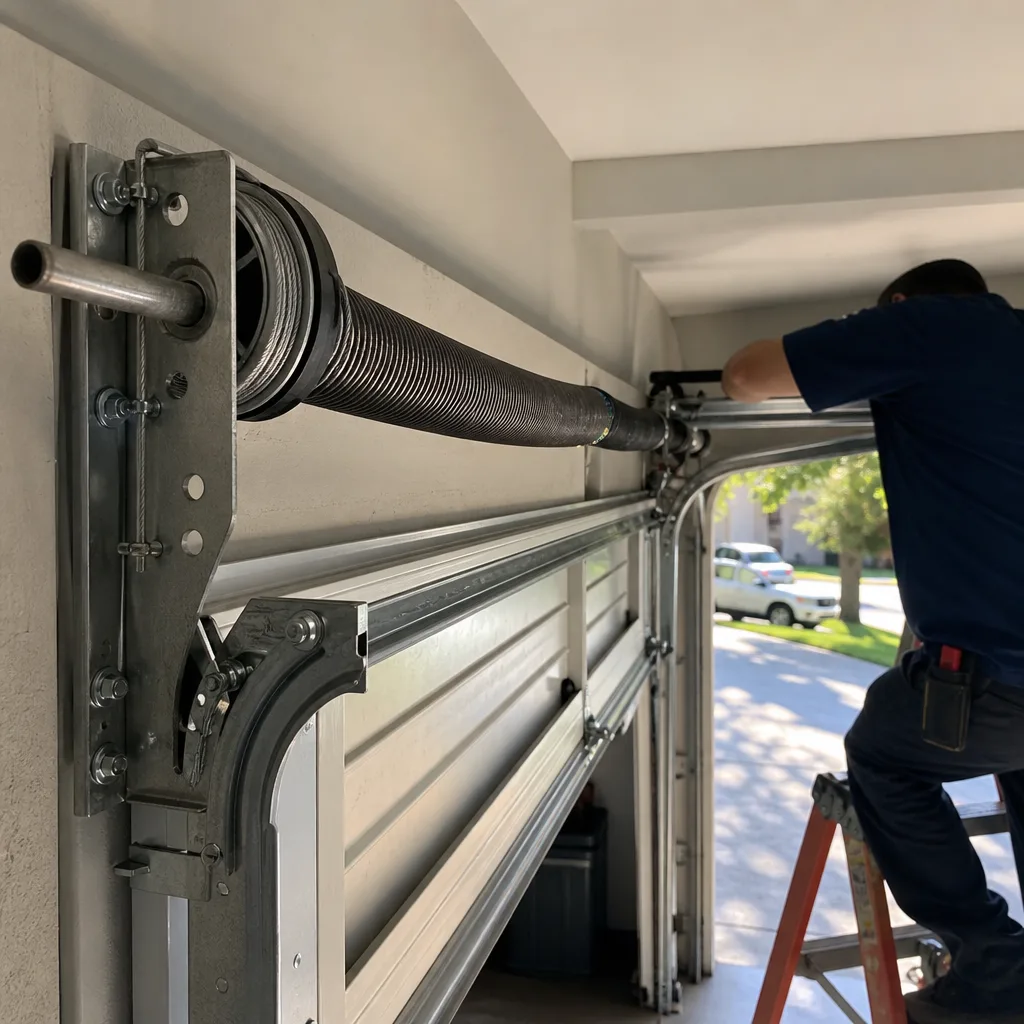
A standard seven-foot residential door with torsion springs has two springs, each wound to counterbalance roughly half the door’s weight. A typical steel door weighs 150 to 200 pounds. The springs are wound tight enough that you can lift the door with one hand. That energy does not disappear when the spring breaks. It releases instantly.
Proper replacement requires winding bars. These are solid steel bars, eighteen inches long, inserted into the cogs of the winding cone. You add or release tension in quarter-turn increments. No screwdriver. No wrench. No substitute. The bars must fit the cone precisely. The wrong size slips. When it slips, the bar becomes a projectile.
We have replaced springs in Cochran’s Crossing where the previous homeowner attempted the job with a pair of adjustable wrenches and a YouTube video. The result was a bent winding cone, a gouge in the ceiling, and a door that would not open at all. The $180 spring replacement became a $340 track and hardware rebuild.
Cable Replacement
Lift cables run from the bottom bracket to the drum at the top of the door. They are under tension whenever the door is not fully open. A frayed cable can snap without warning. Replacing it requires releasing spring tension first, which brings you back to the winding bar problem.
Track Realignment
Bent or misaligned tracks cause the door to bind, which strains the opener and can pull the door off the rollers. Straightening a track requires knowing which direction to bend and how far. Bend it wrong, and the door will never run smooth. In Sterling Ridge, we have seen DIY track repairs that looked straight to the eye but caused uneven wear that destroyed the opener gear within a year.
The Real Cost Comparison: Tools vs. Labor
The economic argument for DIY spring replacement collapses quickly when you price the tools honestly.
| Item | Cost to Acquire | Professional Labor (The Woodlands Market) |
|---|---|---|
| Torsion spring (pair, standard size) | $60-$90 online | Included in service |
| Winding bars (solid steel, proper fit) | $25-$40 | Included in service |
| Winding cone tool | $30-$50 | Included in service |
| Spring caliper (to measure wire size) | $15-$25 | Included in service |
| C-clamps or locking pliers | $15-$30 | Included in service |
| Socket set with extensions | $40-$80 (if you do not own one) | Included in service |
| Safety glasses, gloves | $15-$25 | Included in service |
| Total tool investment | $200-$340 | $180-$280 for complete spring replacement |
The numbers do not lie. Even if you already own a socket set, you are spending $160 to $240 in specialized tools for a job you will perform once every seven to twelve years. A professional spring replacement in The Woodlands typically runs $180 to $280, including the springs, labor, and a warranty. At Mainspring Garage Door Co., we stock standard torsion springs on every truck and complete most spring replacements in a single visit.
There is also the time cost. Your first spring replacement, even with good instructions, will take three to four hours. A trained technician finishes in forty-five minutes to an hour. Factor in a trip to the hardware store, time spent finding the right spring size, and the risk of ordering wrong online, and the professional route saves money and Saturday both.
How The Woodlands Conditions Affect Your Door
The Woodlands sits on clay-heavy soils that shift with moisture. Summer humidity hovers near 90 percent. Winter temperatures dip into the thirties. These conditions create specific maintenance challenges that a generic DIY guide will not address.
Heat and Lubricant Selection
The summer sun heats a south-facing garage to 110 degrees or more. Petroleum-based lubricants thin out and drip onto cars and storage. We see this in April Sound and throughout the Village of Sterling Ridge. Use a synthetic or silicone-based lubricant rated for high temperatures. Reapply in late May, before the worst heat arrives.
Seasonal Metal Expansion
Steel tracks expand in summer and contract in winter. Hardware that was tight in March may be overtightened by August, or loose by January. When DIYers tighten bolts in July without accounting for this cycle, they strip threads or crack brackets. We check hardware tension seasonally during our $89 Seasonal Tune-Up, adjusting for where we are in the expansion cycle.
Slab Settlement and Sensor Alignment
The Woodlands was developed largely in the 1970s through 1990s on former timberland. Slab foundations settle unevenly over decades. A garage floor that pitched slightly when the house was built may now tilt enough that photo-eye sensors, perfectly aligned five years ago, no longer see each other. The fix is not shimming the sensor bracket higher. It is recognizing that the slab has moved and adjusting the sensor angle to compensate, sometimes with a custom bracket. We fabricate these on site when needed.
Wood Rot in Older Neighborhoods
Original Woodlands homes in Grogan’s Mill and Panther Creek often have wooden garage door frames that have seen forty years of humidity. A DIY seal replacement that looks straightforward can reveal rotted jamb wood that will not hold fasteners. We carry treated lumber and composite jamb stock for exactly this situation.
DIY Repairs, Warranty, and Texas Resale Disclosures
This is the point competitors rarely address, and it matters for homeowners who may sell in the next five to ten years.
Manufacturer Warranty
Clopay, Amarr, and most major door manufacturers require that spring, cable, and opener motor repairs be performed by an authorized dealer or certified technician to maintain the warranty. A DIY spring replacement voids the warranty on the door sections and the hardware system. If a panel fails due to stress from an improperly balanced spring, you are buying a new door, not a new panel.
Texas Property Code Disclosure Requirements
Texas Property Code Section 5.008 requires sellers to disclose known defects in structural components, including garage doors. A door that has had DIY spring or cable work, without documentation, becomes a disclosure gray area. Did the previous owner perform the work correctly? Is the door balanced? A professional repair with a written invoice and warranty documentation eliminates that uncertainty.
At Mainspring, every job includes a written invoice that specifies what was done, what parts were used, and the terms of our 90-Day Done Right Promise. That paperwork travels with the house. When you sell, you hand the buyer a folder of documented, warranted work. That is a square deal, and it protects your sale price.
Common Mistakes to Avoid
- Using WD-40 as a lubricant. It is a water displacer and solvent, not a lubricant. In The Woodlands heat, it evaporates and leaves metal dry and squeaking within weeks. Use silicone spray or white lithium grease instead.
- Overtightening hardware in summer. Metal expands in heat. Bolts tightened to spec in July may crack brackets by October when contraction starts. Snug, then back off a quarter turn.
- Replacing only one spring. Torsion springs are matched pairs. When one breaks, the other has the same cycle count and metal fatigue. Replacing one guarantees a second service call within months. Always replace both.
- Misaligning sensors on settled slabs. Do not just shim sensors higher. Check whether the slab itself has tilted. A sensor pointing slightly uphill will lose alignment every time the garage floor flexes under vehicle weight.
- Ignoring cable fraying. A frayed cable is a broken cable waiting to happen. The remaining strands carry overload, and the release is sudden. We have seen frayed cables snap and damage cars in Indian Springs garages.
- Programming a remote without clearing old codes. On Chamberlain and LiftMaster openers, old remotes can conflict with new programming. Hold the learn button for six seconds to clear all codes, then reprogram only the remotes you currently use.
- Attempting spring replacement without winding bars. There is no safe substitute. Screwdrivers, pliers, and ratchet handles slip. The injury statistics from garage door springs are real, and they happen to careful people who thought they could improvise.
When to Call a Professional
Call when the problem involves tension, when the door is off the tracks, when the opener motor hums but the door does not move, or when you have attempted a repair and the symptoms persist. These are not failures of effort. They are indicators that the underlying issue is not what it appeared to be.
In The Woodlands, Mainspring Garage Door Co. offers free estimates. A technician arrives with springs, cables, openers, and hardware on the truck. The flat price is stated before any work begins. Most repairs are completed in a single visit. If you are unsure whether a task is safe to attempt yourself, call (346) 682-0797 and describe what you are seeing. We will tell you straight whether it is a five-minute fix you can handle or a job for a journeyman.
Frequently Asked Questions
Professional torsion spring replacement in The Woodlands typically costs $180 to $340, depending on door size, spring type, and whether cables or other hardware also need replacement. The price is quoted and agreed before work starts. Call (346) 682-0797 for an exact quote on your door. Estimates are free.
You can, but you should not. Torsion springs store lethal energy and require solid steel winding bars, proper training, and precise balance calibration. The tools cost more than professional labor, and the injury risk is severe. We recommend hiring a technician for any spring or cable work.
Yes, for most major brands. Clopay, Amarr, and other manufacturers require authorized service for spring, cable, and opener motor repairs to maintain warranty coverage. A DIY repair that leads to panel or opener failure leaves you paying full replacement cost.
Twice yearly: once in late May before summer heat peaks, and once in November before winter temperature swings begin. Use silicone-based lubricant, not WD-40. The humidity and heat here break down petroleum-based products faster than in drier climates. Follow our Garage Door Repair Maintenance Checklist for The Woodlands Homeowners for the full schedule.
Expansion. Steel tracks and hardware swell in heat. If bolts were tightened to maximum in winter, summer expansion causes binding. Conversely, lubricant that was adequate in March may thin and run off by August. A seasonal tune-up adjusts for these cycles.
Yes. Mainspring Garage Door Co. carries standard torsion springs, extension springs, cables, and openers on every service truck. Most spring replacements in The Woodlands are completed in a single visit, often within hours of your call. Our phones are answered by a live person 24/7, including nights, weekends, and holidays.
The Bottom Line
The DIY-versus-professional question is not about pride or thrift. It is about knowing which garage door tasks carry only inconvenience risk and which carry physical danger. Lubrication, sensor alignment, remote programming, and seal replacement are sensible homeowner maintenance. Spring replacement, cable work, and track realignment require tools, training, and respect for the energy stored in a counterweighted system.
In The Woodlands, where clay soils shift, humidity swells wood, and summer heat tests every lubricant and fastener, the conditions add complexity that a generic online tutorial will not address. The money you might save on a DIY spring repair is typically less than the tool cost, and the downside is a hospital visit or a door that damages your car.
When the job is beyond your comfort, a professional should arrive with the right parts, state the price upfront, and stand behind the work in writing. That is how we have operated since 1984.
Written by Carl Dutton, Owner at Mainspring Garage Door Co., serving The Woodlands since 2016.